You’re Not Lazy: Why Neurodivergent People Struggle to Get Started
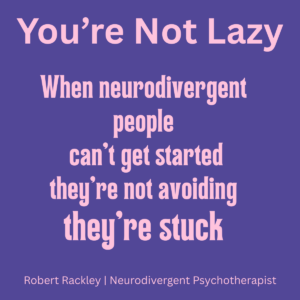
“You’re not lazy.”
This is something many neurodivergent people need to hear.
Because when you can’t start something — whether it’s a task, a piece of work, or even something you want to do — it’s often interpreted as laziness.
But that’s not what’s happening.
What It Feels Like to Be “Stuck”
For many neurodivergent individuals, especially those with ADHD, starting a task can feel overwhelming.
Not because the task is impossible.
Not because there’s no motivation.
But because something in the process doesn’t “click”.
People often describe it as:
- feeling stuck
- knowing what needs to be done but not being able to begin
- wanting to start but feeling blocked
- sitting with the task for long periods without movement
From the outside, this can look like avoidance.
But internally, it’s very different.
Executive Dysfunction and ADHD
This experience is often linked to executive dysfunction.
Executive functions are the mental processes involved in:
- starting tasks
- organising steps
- planning
- shifting attention
- sustaining focus
When these processes are affected, starting becomes difficult.
Even when the intention is there.
Even when the person cares.
This is common in ADHD, and can also be present in autistic individuals.
Why It’s Often Misunderstood
Many people assume:
“If it mattered, you would just do it.”
But for neurodivergent individuals, the issue is not effort or care.
It’s access.
The ability to initiate doesn’t always line up with motivation.
This is why someone can:
- want to do something
- think about it constantly
- feel pressure to do it
and still not be able to start.
The Impact on Self-Perception
Over time, this experience can lead to:
- self-criticism
- feeling lazy or incapable
- frustration
- shame
Many people internalise these difficulties and begin to believe something is wrong with them.
When in reality, it is a difference in how their brain processes tasks.
A Different Way of Understanding It
When we understand executive dysfunction, we begin to shift the narrative.
Instead of asking:
“Why am I so lazy?”
We begin to ask:
- What is making this hard to start?
- What support might help here?
- What would make this task more accessible?
This creates space for understanding rather than self-criticism.
Therapy and Support for Neurodivergent Individuals
If this resonates, you are not alone.
Many neurodivergent adults experience this pattern and often blame themselves for it.
Therapy can help you:
- understand how your brain works
- reduce self-criticism
- develop practical ways to approach tasks
- build more sustainable routines
I provide specialist therapy for neurodivergent individuals, including ADHD and autism.
Sessions are available:
- In person in Limerick
- Online across Ireland and the UK
👉 Book or enquire: www.robertrackley.ie
I also provide training, talks, and podcast contributions on neurodivergence, including ADHD, executive functioning, and the lived experience behind challenges like task initiation and overwhelm.
If you would like to explore training for your team, invite me to speak, or collaborate on a podcast, you are welcome to get in touch.
Email: info@robertrackley.ie
Website: www.robertrackley.ie
About Robert Rackley
Robert Rackley MSc MIACP is a psychotherapist specialising in ADHD, autism, and neurodivergent mental health.
He provides therapy, training, and public speaking focused on improving understanding and support for neurodivergent individuals.