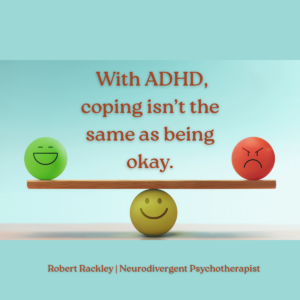
With ADHD, Coping Isn’t the Same as Being Okay
Many adults with ADHD are very good at coping.
They get up.
They go to work.
They meet responsibilities.
They keep going.
From the outside, things often look fine.
However, coping does not always mean someone is okay.
With ADHD, coping usually involves constant effort.
People manage attention, emotions, energy, and expectations in environments that do not suit how their brain works.
As a result, coping can become exhausting.
What Coping Often Looks Like in ADHD
For many adults with ADHD, coping becomes a full-time job.
For example, coping may involve:
pushing through tiredness
masking stress or overwhelm
using anxiety to stay productive
over-preparing to avoid mistakes
holding unrealistically high standards
These strategies can help someone get through the day.
However, they often come at a cost.
Over time, stress builds quietly in the background.
The Mental Health Cost of Constant Coping
When someone is constantly coping, the nervous system rarely gets a break.
Because of this, mental health can be affected.
Over time, this may lead to:
anxiety
emotional exhaustion
irritability or shutdown
reduced confidence
burnout
Many adults with ADHD describe feeling like they are always managing, but never resting.
Although they may appear capable, they often feel depleted inside.
Why Coping Is Often Misunderstood
ADHD is frequently missed in adults who appear articulate or high functioning.
Because people can explain their difficulties clearly, others may assume things are manageable.
As a result:
coping is mistaken for resilience
effort is mistaken for ease
support is delayed or overlooked
However, coping through constant effort is not the same as feeling regulated or well.
Why This Matters for ADHD Mental Health
When coping is mistaken for wellbeing, people are often encouraged to push harder.
Unfortunately, this usually increases pressure rather than reducing it.
In contrast, ADHD mental health improves when:
pacing slows
expectations become realistic
shame is reduced
rest is allowed
support fits the nervous system
For this reason, recognising the difference between coping and being okay matters.
A Final Thought
With ADHD, coping can help someone get through the day.
However, being okay is about how much it costs to do so.
If you are always managing, pushing, or holding things together, that matters.
Support should reduce pressure, not add more.
For Adults
If you are an adult with ADHD, diagnosed or exploring, and this feels familiar, you are not alone.
I offer ADHD-affirming psychotherapy for adults, online and in person in Limerick, with a focus on pacing, safety, and reducing burnout rather than pushing harder.
👉 Learn more or book an appointment:
https://robertrackley.ie
For Professionals & Organisations
Constant coping is a key factor in ADHD-related anxiety and burnout.
I deliver CPD-accredited training on ADHD and neurodivergence for therapists, educators, and organisations. The focus is on recognising hidden effort and adapting support to fit neurodivergent nervous systems.
👉 Learn more about training:
https://robertrackley.ie/training