Why Neurodivergent People Often Research Everything Before Getting Started
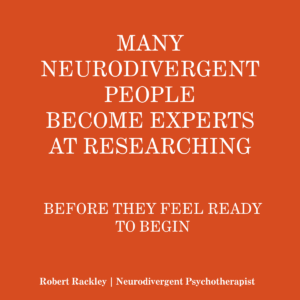
Many neurodivergent people become experts at researching.
They read articles, watch videos, compare options, create plans, and gather information.
Then they research some more.
From the outside, this can sometimes look like procrastination or avoidance. Friends, family members, colleagues, and even professionals may wonder why someone who knows so much about a topic still hasn’t started.
However, for many ADHD and autistic adults, the issue is rarely a lack of motivation.
In fact, it is often the opposite.
The task matters so much that they want to understand it fully before taking the first step.
When Preparation Becomes a Full-Time Job
Many neurodivergent individuals can relate to spending hours researching:
- A new career path
- A university course
- A holiday
- A purchase
- A business idea
- A diagnosis
- A treatment option
- A new hobby
The research itself often feels productive.
It provides information.
It reduces uncertainty.
It creates a sense of control.
The challenge is that there can come a point where preparation begins to replace action.
The individual may know more than enough to get started but still not feel ready.
The Role of Executive Functioning
One reason for this pattern is executive functioning.
Executive functioning refers to the brain’s management system.
It helps us:
- Start tasks
- Prioritise
- Plan
- Organise
- Switch attention
- Manage time
- Follow through
Many ADHD individuals experience difficulties with task initiation.
This means they may know exactly what needs to be done but struggle to begin.
This can be confusing for both the individual and the people around them.
They may have:
- The knowledge
- The skills
- The intention
- The desire
But still find themselves stuck.
Researching can become a way of feeling productive while avoiding the discomfort of getting started.
The Search for Certainty
For many autistic individuals, researching can also serve another purpose.
It creates certainty.
New situations often involve unknowns.
Unknowns can create anxiety.
Information helps reduce that uncertainty.
The more information a person has, the more prepared they feel.
The difficulty is that complete certainty rarely exists.
Eventually there comes a point where action requires accepting some uncertainty.
For many neurodivergent adults, this can be one of the hardest steps.
Perfectionism and Fear of Getting It Wrong
Many ADHD and autistic adults have spent years receiving criticism.
They may have been told they were:
- Lazy
- Disorganised
- Careless
- Too sensitive
- Not trying hard enough
Over time, some develop perfectionistic tendencies.
If they can gather enough information, perhaps they can avoid mistakes.
If they understand every possible outcome, perhaps they can avoid failure.
Unfortunately, perfectionism often creates a moving target.
No amount of information ever feels quite enough.
No amount of preparation ever feels complete.
As a result, people can become trapped in an endless cycle of learning without doing.
Decision Paralysis
Another common factor is decision paralysis.
The more options available, the harder it can become to choose.
Many neurodivergent adults are highly aware of potential consequences.
They can see:
- Multiple possibilities
- Multiple outcomes
- Multiple risks
While this can be a strength, it can also become overwhelming.
Instead of making a decision, the brain seeks more information.
The hope is that one more article, one more video, or one more opinion will provide clarity.
Often it doesn’t.
It simply creates more information to process.
Why Knowledge Does Not Always Lead to Action
One of the most misunderstood aspects of neurodivergence is that knowing and doing are not always the same thing.
Many people assume:
“If you understand what needs to happen, why don’t you just do it?”
The reality is that insight and action involve different processes.
A person can:
- Understand the solution
- Agree with the solution
- Want the solution
And still struggle to take the first step.
This is particularly common in ADHD, where executive functioning difficulties can create a gap between intention and action.
Moving From Research to Action
The goal is not to stop researching.
Research is often a genuine strength.
Many neurodivergent individuals become incredibly knowledgeable, thoughtful, and informed because of their ability to explore topics in depth.
The challenge is recognising when additional information is no longer helping.
Some useful questions include:
- Do I already know enough to take the next step?
- Am I seeking information or certainty?
- What is the smallest possible action I could take today?
- What would progress look like instead of perfection?
Often the next step does not need to be a giant leap.
It may simply involve sending an email, making a phone call, filling out an application, booking an appointment, or starting a task for five minutes.
Small actions create momentum.
Momentum creates confidence.
Confidence often reduces the need for endless preparation.
Understanding Yourself Matters
Many neurodivergent adults spend years criticising themselves for these patterns.
They describe themselves as lazy, unmotivated, indecisive, or incapable.
In reality, these behaviours often make much more sense when viewed through the lens of ADHD, autism, executive functioning, anxiety, and uncertainty.
Understanding why a pattern exists does not solve it overnight.
However, it often replaces shame with self-awareness.
And that is usually where meaningful change begins.
Specialist ADHD and Autism Therapy
If you recognise yourself in this article and would like support understanding ADHD, autism, executive functioning difficulties, anxiety, perfectionism, or decision paralysis, I provide specialist psychotherapy for adults both online and in person from my practice in Limerick, Ireland.
I also provide neurodiversity training, consultancy, and speaking engagements for therapists, healthcare services, educational settings, and workplaces.
Related Services
ADHD and Autism Therapy:
https://robertrackley.ie/therapy-services/
Neurodiversity Training and Speaking:
https://robertrackley.ie/events-talks/
Online ADHD Courses:
https://robertrackley.ie/courses/
Contact Robert Rackley:
https://robertrackley.ie/contact/