
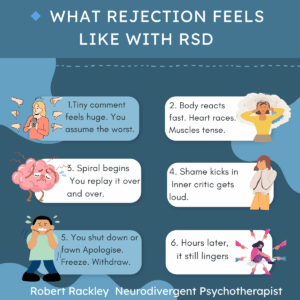
What Rejection Feels Like With RSD
It’s not “overreacting.” It’s your nervous system sounding the alarm.
For many of us, diagnosed or not, even a passing comment or shift in tone can trigger hours (or days) of self-doubt.
You might find yourself replaying a moment, trying to decode what went wrong, feeling shame even when nothing was wrong.
This isn’t about being “too sensitive.” It’s often RSD, a trauma-like response that hits hard and fast, especially in neurodivergent nervous systems shaped by years of masking, misunderstanding, or feeling like we’re always “too much.”
If you feel this, you’re not alone.
Can you relate to this cycle?
What Is Rejection Sensitive Dysphoria (RSD)?
Rejection Sensitive Dysphoria (RSD) is an intense emotional reaction to perceived criticism, rejection, disapproval, or failure.
Many ADHD adults describe RSD as feeling sudden, overwhelming, and disproportionate to the situation itself.
A small comment.
A delayed reply.
A change in someone’s tone.
A misunderstanding.
All can trigger intense feelings of shame, embarrassment, anxiety, or self-doubt.
Although RSD is not part of the formal diagnostic criteria for ADHD, it is widely recognised by ADHD specialists and is one of the most commonly discussed experiences among ADHD adults.
Why Does RSD Feel So Intense?
For many neurodivergent individuals, RSD is not just about the present moment.
The reaction is often influenced by years of experiences such as:
- Being misunderstood
- Being criticised
- Being told to try harder
- Social rejection
- Feeling different
- Masking
Over time, the nervous system can become highly sensitive to signs of rejection or criticism.
What appears small from the outside can feel enormous internally.
RSD and Self-Doubt
One of the most painful aspects of RSD is the impact it can have on self-esteem.
Many ADHD adults spend years questioning themselves, second-guessing decisions, and wondering whether they have done something wrong.
The criticism may come from other people initially.
Eventually, it often becomes internal.
RSD and Relationships
RSD can affect friendships, romantic relationships, family relationships, and work relationships.
Someone experiencing RSD may:
- Assume they have upset someone
- Fear abandonment
- Seek reassurance
- Withdraw after perceived criticism
- Replay conversations repeatedly
This can be exhausting emotionally and mentally.
RSD and Burnout
Living in a constant state of emotional vigilance can be draining.
Many ADHD adults experience emotional exhaustion from repeatedly monitoring interactions, analysing conversations, and worrying about rejection.
Over time this can contribute to burnout and reduced confidence.
What Helps?
Understanding RSD is often the first step.
Many people feel enormous relief when they realise there is a name for what they have been experiencing.
Helpful strategies may include:
- Psychoeducation
- Self-compassion
- Emotional regulation skills
- Challenging assumptions
- Learning to tolerate uncertainty
- Neurodivergent-informed therapy
Progress is not about becoming immune to rejection.
It is about understanding your reactions and responding to them differently.
How Therapy Can Help
Many ADHD adults spend years believing they are overly sensitive, dramatic, or emotionally weak.
Learning about RSD often helps people realise there is a reason these experiences feel so intense.
Neurodivergent-informed therapy can help individuals understand their emotional responses, reduce shame, improve self-compassion, and develop healthier ways of responding to criticism and rejection.
Learn More About ADHD
Some people find it helpful to learn more about ADHD and emotional regulation through structured psychoeducation.
You can also explore my ADHD courses:
Diagnosed with ADHD: Now What?
These courses provide practical information on ADHD, emotional regulation, self-understanding, and moving forward with greater confidence.
Related Articles
Many ADHD Adults Struggle to Trust Themselves
What Masking in ADHD and Autism Really Looks Like and Why It’s So Often Missed
Neurodivergent Burnout Is a Mental Health Crisis, Not Just Exhaustion
ADHD Energy Explained: How to Work With Bursts and Avoid Burnout
Need Support?
If you are an ADHD or autistic adult struggling with Rejection Sensitive Dysphoria, self-doubt, burnout, or emotional overwhelm, support is available.
I provide neurodiversity-affirming therapy online worldwide and in person in Limerick.
Learn more about ADHD Therapy, Autism Therapy, or book an appointment today.
About the Author
Robert Rackley MSc MIACP is a neurodivergent psychotherapist diagnosed with combined type ADHD, specialising in ADHD, autism, and neurodivergent mental health.
Based in Limerick, Ireland, he provides therapy, training, and public speaking on ADHD, autism, masking, burnout, emotional regulation, and neurodiversity.
Follow me on LinkedIn