
What Masking in ADHD and Autism Really Looks Like (And Why It’s So Often Missed)
Most People Get Neurodivergence Wrong
Most people have a picture in their head of what “neurodivergent” looks like.
And most of the time… it’s wrong.
There’s an assumption that neurodivergence is always visible:
- obvious struggles
- clear differences
- someone who stands out
But in reality, many neurodivergent adults don’t stand out at all.
They blend in.
They cope.
They function.
And that’s exactly why they’re often missed.
What Neurodivergence Actually Looks Like
In everyday life, neurodivergence often looks like:
- Showing up and getting through the day
- Smiling and saying the “right” thing
- Holding it together in work, relationships, and social settings
But beneath that, there is often a very different experience.
It can look like:
- Forcing eye contact when it feels uncomfortable
- Rehearsing conversations in your head before speaking
- Pushing through sensory discomfort
- Constantly monitoring how you come across
- Keeping everything contained until you’re alone
From the outside, it looks like coping.
From the inside, it can feel like constant effort.
What Is Masking?
Masking is the process of hiding or suppressing natural behaviours, responses, or needs in order to fit into social expectations.
This is very common in:
- ADHD
- Autism
- Other forms of neurodivergence
Masking is often learned early—sometimes consciously, often not.
It develops as a way to:
- avoid judgement
- reduce conflict
- fit in socially
- meet expectations in school, work, or family environments
And in the short term, it works.
It helps people get through situations.
But it comes at a cost.
The Hidden Cost of Masking
Masking doesn’t remove difficulty—it relocates it.
Instead of being visible externally, the strain is carried internally.
What people don’t see is:
- the exhaustion after social interaction
- the shutdown later in the day
- the burnout that builds over time
Masking keeps the nervous system under constant pressure.
It requires:
- ongoing self-monitoring
- emotional regulation
- cognitive effort
- suppression of natural responses
Over time, this can lead to:
- chronic fatigue
- anxiety
- low mood or depression
- identity confusion
- burnout
This is often why neurodivergent adults seek support later in life—not because it wasn’t there, but because they were able to mask it.
Until they couldn’t anymore.
Why Masking Leads to Missed Diagnoses
Many adults with ADHD or autism go undiagnosed because they appear to be:
- functioning well
- socially capable
- managing responsibilities
But this external presentation can be misleading.
Clinically, it’s important to look beyond:
- performance
- presentation
- surface-level coping
And instead explore:
- effort
- internal experience
- recovery time after tasks or interaction
- long-term patterns of exhaustion
Masking can make someone look “fine” in a session, in work, or socially.
But that doesn’t mean they are.
The Role of Therapy
In therapy, masking can show up as:
- saying the “right” things
- minimising difficulties
- intellectualising experiences
- appearing more regulated than they feel
This is why therapy needs to be:
- paced
- non-demanding
- attuned to the nervous system
- adapted for neurodivergent clients
The goal isn’t to immediately remove masking.
It’s to create enough safety that it becomes less necessary.
Moving Towards Understanding (Not Just Coping)
For many neurodivergent adults, the shift isn’t about “fixing” themselves.
It’s about:
- understanding their patterns
- reducing internal pressure
- developing supports that actually work
- allowing themselves to be more authentic
Masking may have helped them survive.
But long-term wellbeing often comes from needing it less, not doing it better.
Final Thought
Neurodivergence is often missed not because it isn’t there—
but because people have become very good at hiding it.
And what looks like coping from the outside
is often coming at a significant internal cost.
Training for Professionals and Organisations
Masking is not just a personal experience—it’s something that is often missed or misunderstood by professionals.
In many settings, including therapy, healthcare, education, and workplaces, individuals who are masking can be perceived as:
- coping well
- engaging appropriately
- not requiring additional support
But this can lead to:
- missed diagnoses
- inappropriate interventions
- burnout being overlooked
- support needs going unmet
Understanding masking requires a shift from focusing only on what is visible, to exploring:
- internal effort
- sensory load
- emotional regulation demands
- the impact of sustained pressure over time
This is a key part of neurodiversity-informed practice.
Neurodiversity Training
I provide CPD training for mental health professionals, healthcare staff, and organisations who want to better understand and support neurodivergent individuals.
My training focuses on:
- recognising masking in ADHD and autistic individuals
- understanding the nervous system impact of masking
- adapting communication and therapeutic approaches
- reducing misinterpretation of behaviours
- practical strategies to support regulation and engagement
The aim is to move beyond awareness and provide clear, practical tools that can be applied in real-world settings.
Why This Matters
When masking is misunderstood, individuals are often:
- seen as coping when they are overwhelmed
- offered supports that don’t match their needs
- left without appropriate intervention
When it is understood, professionals can:
- respond more accurately
- reduce pressure on the individual
- create environments where masking is less necessary
This can have a significant impact on both mental health outcomes and long-term wellbeing.
Learn More
If your team or organisation would benefit from training in this area, you can learn more or get in touch via:
www.robertrackley.ie
If this resonates with you, you’re not alone.
Many adults begin to question ADHD or autism later in life—especially when coping strategies stop working or lead to burnout.
If you’d like to explore this further, you can:
- Learn more about my work at www.robertrackley.ie
- Or book a session to explore your experience in a structured, supportive way
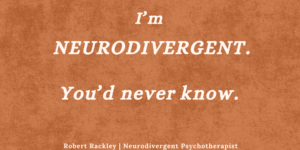
Masking can look like coping on the outside, but often comes with a hidden internal cost