RSD and Imposter Syndrome: When Feedback Makes You Question Whether You Belong
By Robert Rackley MSc MIACP
Neurodivergent Psychotherapist | ADHD & Autism Specialist
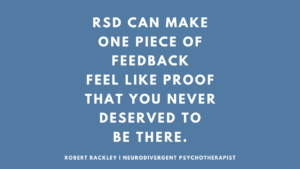
RSD can make one piece of feedback feel like proof that you never deserved to be there.
A manager suggests a small change.
A colleague questions part of your work.
Someone responds differently than expected.
An email feels shorter than usual.
You make one mistake.
To another person, the moment may appear minor. It may be understood as ordinary feedback, a misunderstanding or simply part of working and learning.
But when Rejection Sensitive Dysphoria and imposter syndrome come together, that moment can feel much bigger.
The feedback is no longer only about one piece of work.
It becomes a judgement of your entire ability.
A suggestion becomes evidence that you are failing.
A mistake becomes proof that your success was never real.
And the fear underneath it all may be:
“They have finally realised that I don’t belong here.”
What is Rejection Sensitive Dysphoria?
Rejection Sensitive Dysphoria, commonly shortened to RSD, is a term used to describe an intense emotional response to rejection, criticism or the belief that somebody is disappointed in you.
It is often discussed in relation to ADHD and emotional regulation. However, RSD is not a formal diagnosis or separate disorder in major diagnostic manuals.
The term remains meaningful to many neurodivergent adults because it gives language to an experience that can otherwise be difficult to explain.
RSD may be triggered by actual rejection, but it can also arise from uncertainty or perceived rejection.
A delayed reply.
A change in somebody’s tone.
A neutral facial expression.
A piece of constructive feedback.
Not being included in a conversation.
Someone disagreeing with an idea.
The possibility that you may have disappointed another person.
The emotional response can arrive very quickly and feel overwhelming. There may be shame, panic, anger, sadness or an urgent desire to repair the situation.
As I discuss in What Rejection Feels Like With RSD, the intensity is often shaped not only by the present moment but also by years of criticism, misunderstanding, masking and feeling different.
What is imposter syndrome?
Imposter syndrome describes the experience of doubting your achievements and fearing that other people have overestimated your ability.
Despite evidence of competence, the person may believe:
- I have only been lucky.
- Other people know much more than I do.
- I have somehow fooled everyone.
- I should be more capable by now.
- I do not deserve this position.
- One mistake will expose me.
- Everyone else belongs here more than I do.
- If people knew the real me, they would think differently.
Success does not necessarily reduce these fears.
In fact, greater success can sometimes intensify them.
A promotion may create fear that expectations will increase.
Recognition may feel uncomfortable because the person does not believe they have earned it.
A new opportunity may produce anxiety rather than confidence.
Instead of viewing an achievement as evidence of ability, they explain it away as luck, timing or other people being generous.
RSD and imposter syndrome are not the same experience.
But they can reinforce each other.
How RSD can feed imposter syndrome
RSD intensifies the emotional impact of perceived criticism or rejection.
Imposter syndrome then gives that feeling a story.
The RSD response may be:
“This feedback feels deeply painful.”
Imposter syndrome interprets that pain as:
“It hurts this much because the feedback proves I am not good enough.”
The emotional reaction begins to feel like evidence.
Instead of recognising that they are experiencing a strong response, the person assumes the intensity must reflect the seriousness of what has happened.
One comment becomes proof of incompetence.
One correction appears to invalidate years of experience.
One disappointed response seems to cancel every positive one.
This can create a powerful cycle:
- The person receives feedback or notices possible disapproval.
- RSD triggers an intense emotional response.
- The person feels shame, anxiety or panic.
- Imposter thoughts interpret the emotion as proof that they do not belong.
- They overwork, withdraw, apologise or seek reassurance.
- The original belief that they are not good enough becomes stronger.
The person is no longer responding only to the feedback.
They are responding to everything they believe the feedback says about them.
Why feedback can feel so threatening
Feedback is intended to help people learn, improve or clarify expectations.
However, it can feel threatening when somebody has learned to connect performance with personal worth.
Many ADHD adults grow up receiving frequent corrections.
They may be told that they are:
- Not trying hard enough
- Careless
- Disorganised
- Too emotional
- Too sensitive
- Inconsistent
- Not living up to their potential
- Capable of doing better “if they would only apply themselves”
These messages can gradually become internal beliefs.
The person may enter adulthood expecting mistakes to reveal something fundamentally wrong with them.
This is particularly likely when ADHD was not recognised earlier. Without an explanation for executive functioning, attention, emotional regulation or working-memory differences, struggles may have been interpreted as failures of character.
Even after an ADHD diagnosis, the emotional impact of those earlier experiences does not automatically disappear.
A diagnosis may explain why something was difficult.
It does not instantly remove years of shame.
This is why the hidden signs of ADHD in adulthood often extend far beyond concentration. They can include masking, self-doubt, emotional sensitivity and a deeply rooted fear of getting things wrong.
RSD and imposter syndrome at work
The workplace can be a particularly powerful setting for this pattern.
Work often involves evaluation, deadlines, unclear social expectations and comparison with other people. It may also involve managers whose communication styles are brief, indirect or inconsistent.
An employee may receive feedback such as:
“Could you change this section?”
What they hear internally is:
“You should have known how to do this.”
“We made a mistake hiring you.”
“Everyone else is more capable.”
“You are about to be exposed.”
The person may understand logically that the feedback is limited to one task. Emotionally, however, it can feel as though their entire position is under threat.
This may lead to:
- Overpreparing for ordinary tasks
- Working longer hours than necessary
- Rechecking work repeatedly
- Avoiding asking questions
- Becoming distressed before reviews or meetings
- Reading criticism into neutral emails
- Struggling to speak after receiving feedback
- Withdrawing from colleagues
- Seeking repeated reassurance
- Turning down promotions or opportunities
- Avoiding tasks where their work will be evaluated
- Feeling unable to enjoy praise
- Considering leaving a job after one difficult interaction
From the outside, the employee may appear highly conscientious.
Their manager may see excellent preparation, attention to detail and commitment.
What remains hidden is the fear driving it.
Perfectionism can become protection
Perfectionism is often described as wanting everything to be excellent.
For somebody affected by RSD and imposter syndrome, it may be less about excellence and more about protection.
“If I do everything perfectly, nobody can criticise me.”
“If I prepare for every possibility, I will not be exposed.”
“If I work harder than everyone else, I will prove I deserve to be here.”
“If I never make a mistake, I will be safe.”
Perfectionism may help the person achieve a great deal.
But it rarely creates a lasting sense of competence.
Each success is explained by the amount of effort used to prevent failure. The person does not conclude, “I did well because I am capable.”
They conclude, “I only succeeded because I worked far harder than should have been necessary.”
The success therefore becomes further evidence of being an imposter.
Other people seem to manage naturally.
The person sees only their own anxiety, preparation, missed breaks and late nights.
They compare everyone else’s visible result with their own invisible process.
When coping looks like competence
Many neurodivergent adults become extremely skilled at hiding uncertainty.
They prepare more.
Double-check everything.
Observe other people carefully.
Rehearse what to say.
Avoid situations in which they might not know the answer.
They may appear confident, organised and successful.
This can make it difficult for others to understand why feedback affects them so deeply.
It may also increase the person’s imposter feelings.
The more convincing the performance becomes, the more they fear that nobody knows the “real” version underneath.
But the coping strategies do not mean their achievements are false.
The effort involved does not cancel their ability.
As I explore in Many ADHD and Autistic Adults Have Become So Good at Coping That Nobody Realises They Are Struggling, visible competence can exist alongside significant internal distress.
You can be capable and anxious.
Experienced and uncertain.
Successful and overwhelmed.
Needing support does not make your achievements less real.
RSD can make positive feedback difficult to believe
A person experiencing imposter syndrome may dismiss positive feedback very quickly.
If someone praises their work, they may think:
“They are only being polite.”
“They do not know how much help I needed.”
“They would not say that if they knew how anxious I was.”
“I should have done it faster.”
“Anyone could have done this.”
“They expect even more from me now.”
One critical comment may be replayed for days, while ten positive comments disappear almost immediately.
This creates an unfair internal system of evidence.
Criticism is treated as objective truth.
Praise is treated as a misunderstanding.
Mistakes reveal the real person.
Achievements are explained away.
When this pattern continues, there is almost no way for the person to feel genuinely competent. Every possible outcome is interpreted through the belief that they do not belong.
Self-doubt can appear before anyone criticises you
RSD is not always a response to something another person has said.
Sometimes the anticipation of rejection is enough.
Before sending an email, the person imagines how it could be misunderstood.
Before contributing to a meeting, they predict that the idea will sound foolish.
Before applying for a job, they identify every area where they may fall short.
Before setting a boundary, they anticipate the other person’s disappointment.
Before sharing their work, they prepare for criticism.
The person may talk themselves out of opportunities before anybody else has responded.
This is one reason ADHD and autistic adults may talk themselves out of what they need. The anticipated rejection feels so real that avoidance appears safer than finding out what might happen.
But avoidance has its own cost.
The person misses opportunities that could challenge their belief that they are not capable.
They then interpret the lack of progress as further evidence of inadequacy.
People-pleasing and overexplaining
RSD and imposter syndrome can also affect how somebody communicates.
A person may believe they must keep everyone happy to remain accepted.
They may:
- Say yes when they do not have capacity
- Take responsibility for other people’s feelings
- Apologise excessively
- Provide long explanations for ordinary decisions
- Avoid disagreeing with colleagues
- Change their opinion after noticing another person’s reaction
- Work beyond their role to prove their value
- Struggle to set boundaries
- Try to repair situations that are not actually damaged
Overexplaining can be an attempt to prevent misunderstanding or rejection.
The person wants to ensure that nobody can interpret their actions negatively.
But the more they explain, the more vulnerable and uncertain they may feel afterwards.
They replay the conversation.
Wonder whether they said too much.
Imagine how they were perceived.
Consider sending another message to clarify.
This is not simply low confidence.
It can be a nervous-system response shaped by repeated experiences of being misunderstood.
Withdrawal can be mistaken for not caring
Not everyone responds to RSD by trying harder or seeking reassurance.
Some people withdraw.
They stop contributing in meetings.
Avoid the colleague who gave the feedback.
Delay opening messages.
Say they are no longer interested in an opportunity.
Become emotionally distant.
Leave a job or relationship before they can be rejected.
From the outside, withdrawal can look like defensiveness, stubbornness or a lack of commitment.
Internally, the person may be protecting themselves from further pain.
“If I stop trying, I cannot fail.”
“If I leave first, they cannot reject me.”
“If I pretend not to care, nobody will know how much this affected me.”
Withdrawal may offer short-term relief, but it often strengthens the belief that feedback is dangerous and that mistakes cannot be survived.
When a reaction becomes another source of shame
After the initial RSD response settles, a second layer of shame may appear.
The person may think:
“Why did I react so strongly?”
“I have embarrassed myself.”
“Other adults do not respond like this.”
“I am too sensitive.”
“I have proved that I am not professional enough.”
The person now feels ashamed about the original feedback and ashamed of their response to it.
This can deepen imposter syndrome.
They may believe that a competent adult would have handled the situation calmly and moved on.
But emotional regulation is not a measure of intelligence, ability or professional worth.
A strong reaction does not prove that somebody is incapable.
It tells us that something in the situation felt threatening to their nervous system.
Understanding that response does not mean ignoring harmful behaviour or avoiding responsibility. It means recognising what happened so the person can respond differently without using shame as the strategy.
Separating the feedback from the story
One helpful step is learning to separate what was actually said from what the mind added.
For example:
What was said:
“This section needs more detail.”
The story:
“They think I am incompetent.”
Or:
What happened:
“My manager did not respond today.”
The story:
“They are unhappy with me.”
Or:
What was said:
“We chose another candidate.”
The story:
“I was foolish to believe I was qualified.”
The story may feel completely true in the moment.
That does not mean it is supported by the available evidence.
Useful questions can include:
- What exactly was said?
- What meaning have I attached to it?
- Is this feedback about me or about one piece of work?
- Am I treating a feeling as proof?
- Is there another possible explanation?
- What evidence supports the belief that I do not belong?
- What evidence have I dismissed?
- Would I judge another person this harshly?
- What would a proportionate response look like?
- Do I need to respond now, or can I allow time for the intensity to settle?
The aim is not to argue with the emotion.
The emotion is real.
The aim is to question whether the conclusion created during that emotion is accurate.
Allowing the nervous system time to settle
RSD can create an urgent need to act.
You may want to apologise immediately.
Send a long explanation.
Resign.
Withdraw.
Challenge the feedback.
Ask several people for reassurance.
Make a major decision about your future.
When possible, it can help to create space between the emotional response and the action.
This might mean:
- Leaving the email unanswered until later
- Taking a short sensory or nervous-system break
- Writing a response without sending it
- Moving away from the immediate environment
- Using slow breathing or grounding
- Speaking to someone who understands the pattern
- Returning to the feedback when the intensity has reduced
- Asking for clarification rather than assuming the worst
The purpose of a pause is not to suppress the feeling.
It is to prevent a temporary emotional state from making a permanent decision.
Rebuilding trust in your competence
Imposter syndrome is not resolved simply by being told that you are good enough.
Reassurance may help briefly, but it often fades.
Rebuilding trust involves learning to recognise evidence that your mind usually dismisses.
That may include:
- Keeping a record of positive feedback
- Noticing skills you use automatically
- Recording achievements without immediately minimising them
- Recognising that effort does not invalidate ability
- Identifying situations you have handled effectively
- Accepting praise without explaining it away
- Viewing mistakes as information rather than exposure
- Comparing yourself with your earlier development rather than another person’s visible performance
- Recognising the effect of inaccessible environments
- Allowing yourself to learn without already knowing everything
It can also involve redefining competence.
Competence does not mean never becoming uncertain.
It does not mean working without support.
It does not mean knowing everything immediately.
It means having knowledge and ability while remaining capable of learning, adapting and asking for help.
Feedback should be clear, specific and safe
Organisations and managers also influence how feedback is received.
The solution is not to avoid giving neurodivergent employees feedback. Honest feedback is part of supportive professional relationships.
But feedback can be delivered more effectively.
Helpful feedback is:
- Specific rather than vague
- Focused on the work rather than the person’s character
- Clear about what needs to change
- Balanced with recognition of what is working
- Delivered privately
- Offered with enough processing time
- Consistent rather than saved for moments of frustration
- Followed by an opportunity to ask questions
- Free from unnecessary shame or humiliation
A manager may not know that an employee experiences RSD.
But clear and respectful communication benefits everyone.
Psychological safety does not mean nobody experiences discomfort. It means feedback can be discussed without the employee feeling that one mistake has removed their right to belong.
You are more than the moment you got wrong
One piece of feedback cannot measure an entire career.
One mistake cannot erase years of experience.
One difficult conversation cannot define your value.
The strength of your emotional response does not prove that your worst fear is true.
RSD can make feedback feel enormous.
Imposter syndrome can turn that feeling into a judgement about who you are.
But feelings are not verdicts.
You may need time to process what happened.
You may need to separate the useful part of the feedback from the shame attached to it.
You may need support to recognise the difference between improving something and proving that you never deserved to be there.
You can learn from feedback without allowing it to become a judgement of your entire worth.
You can make mistakes and remain capable.
You can need guidance and still belong.
You can feel uncertain without being an imposter.
RSD can make one piece of feedback feel like proof that you never deserved to be there.
But one moment does not cancel everything that brought you there.
Therapy, Training and Speaking
I provide ADHD-focused therapy before and after diagnosis for adults experiencing RSD, imposter syndrome, emotional overwhelm, masking, perfectionism and persistent self-doubt.
My approach combines clinical experience, specialist training and my own lived experience of ADHD. The aim is not to remove emotional sensitivity, but to help you understand your responses, reduce shame and develop strategies that work with your neurodivergent brain.
Sessions are available in person in Limerick and online internationally. You can learn more about my neurodivergence-affirming approach to therapy.
I also deliver neurodiversity training, workplace talks and professional CPD for organisations, healthcare professionals, therapists and educational settings. Training can include RSD, emotional regulation, masking, burnout, workplace communication and supporting neurodivergent employees.
For adults exploring whether ADHD may explain their experiences, my therapist-led online course, Could I Have ADHD?, provides accessible information about adult ADHD and the patterns often missed earlier in life.
Robert Rackley MSc MIACP
Neurodivergent Psychotherapist | ADHD & Autism Specialist | Trainer & Speaker