The Child Who Never Caused Trouble: When Having Needs Felt Unsafe
By Robert Rackley MSc MIACP
Neurodivergent Psychotherapist | ADHD & Autism Specialist
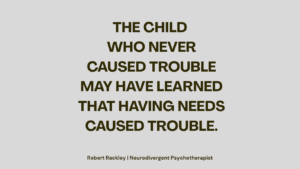
The child who never caused trouble may have learned that having needs caused trouble.
Adults may remember them as quiet, polite, helpful and unusually independent.
They rarely complained or asked for support. In fact, teachers might have described them as mature for their age, easy to teach or no trouble at all.
However, an absence of difficult behaviour does not always mean an absence of distress.
Some quiet children feel secure, content and comfortable observing before they participate. Others genuinely enjoy their independence.
For some children, though, staying quiet becomes a way of staying safe.
Perhaps they hide confusion rather than ask another question. They might tolerate sensory discomfort to avoid attracting attention. At other times, they agree when they want to say no.
Eventually, the child may become useful when what they really need is care.
Saying “I’m fine” can feel safer than trying to explain something they cannot yet put into words.
Of course, quietness or compliance does not prove that a child is neurodivergent, anxious, traumatised or masking. Nevertheless, adults should not treat good behaviour as automatic evidence that a child feels safe and supported.
Quiet neurodivergent children can be overlooked
When people imagine a child with ADHD, they may picture somebody who is visibly restless, impulsive or disruptive.
Likewise, people may expect an autistic child to show clear social, communication or behavioural differences.
Some children do present in these ways. In contrast, others direct their difficulties inward.
For example, an ADHD child may daydream, lose track of instructions or struggle silently with working memory. Although the child finds school difficult, they may cause very little disruption.
As a result, adults may overlook their difficulties.
The NHS notes that clinicians may recognise ADHD less often in women because inattentive symptoms can be harder to identify. These overlooked patterns often begin during childhood.
Similarly, some autistic children learn to watch other people closely. They may copy expected behaviour, suppress visible discomfort and avoid doing anything that makes them appear different.
The National Autistic Society describes masking as a conscious or unconscious strategy that some autistic people use to appear non-autistic. Masking may help someone navigate school or social situations. However, it can also affect mental health, identity and access to support.
Therefore, a child who looks calm may be using considerable energy to remain calm.
Following every instruction does not necessarily mean that the child understands it. Equally, completing schoolwork does not tell us how much anxiety, perfectionism or self-monitoring the task required.
Being easy to manage is not the same as feeling safe
Adults naturally notice behaviour that requires an immediate response.
A child who shouts, leaves the room or refuses a task can be difficult to overlook. Meanwhile, the child who remains silent may appear to need very little.
Behaviour is not the only measure of wellbeing, though.
A child may remain compliant because:
- They fear being corrected
- They do not want to disappoint an adult
- They cannot explain what feels wrong
- Previous questions attracted negative attention
- They worry about appearing difficult
- They freeze when overwhelmed
- They need more processing time
- They believe other people’s needs matter more
- They hide distress until they reach a safer environment
The behaviour may make life easier for the adults around them. However, maintaining it could cost the child a great deal internally.
Instead of asking only, “Is this child behaving?”, we also need to ask:
Does this child feel safe enough to express confusion, discomfort and disagreement?
The child may not recognise their own struggle
Children do not always know that their internal experience differs from somebody else’s.
For instance, a child may assume that everyone finds noise physically uncomfortable. They might also believe that everyone rehearses what to say or copies other children to understand what is expected.
Perhaps they think every child becomes exhausted after school, fears making small mistakes or spends the day trying not to attract attention.
Because the experience has always been present, it may not seem unusual or worth mentioning.
Furthermore, the child may not have the language to describe sensory overload, executive dysfunction or emotional distress.
Some ADHD and autistic children experience alexithymia, which can make identifying and describing emotions more difficult.
When an adult asks, “What’s wrong?”, the child may genuinely answer:
“I don’t know.”
Their body may feel tense, tired or desperate to escape. Even so, turning that experience into a clear explanation may feel impossible.
My article on alexithymia in ADHD and autism explains why difficulty naming an emotion does not mean the emotion is absent.
Asking for help may feel harder than struggling alone
Adults sometimes tell children:
“You only had to ask.”
However, asking for help is a skill that develops through experience.
A child needs to learn that adults will receive questions patiently. They also need to know that uncertainty will not lead to ridicule, anger or disappointment.
If adults previously dismissed or misunderstood their attempts to communicate, staying silent may feel safer.
The child may have heard:
“You know how to do this.”
“We’ve already explained it.”
“Everyone else has started.”
“There’s nothing wrong with that noise.”
“You’re too sensitive.”
“Stop making a fuss.”
“You’re old enough to manage this yourself.”
Adults may say these things without intending harm. Nevertheless, the child can absorb a much broader message:
My needs create problems.
Consequently, they may stop asking for help before anyone realises that they have stopped.
Independence can become protection
Independence can support a child’s confidence and development.
For example, learning to organise belongings, complete tasks and solve problems can feel empowering. Yet independence is not always freely chosen.
Some children become highly independent because relying on other people feels uncertain.
Their thoughts may include:
“It is easier to do it myself.”
“I should already know.”
“If I need help, I have failed.”
“Other people have more important problems.”
“I don’t want anybody to become annoyed with me.”
Adults may then praise the child for being mature and self-sufficient. Unfortunately, that praise can strengthen the belief that needing less makes them more acceptable.
Soon, they become the reliable child, the helpful student or the sibling who never adds to family stress.
Their competence may be genuine. Even so, competence does not remove a child’s need for care.
A child should not have to choose between receiving respect and receiving support.
Perfectionism can keep distress hidden
Some quiet children use perfectionism to avoid criticism or attention.
They prepare carefully, check their work and follow rules exactly. In addition, small mistakes may cause significant distress.
From the outside, this pattern can look like motivation or conscientiousness.
Underneath, the child may hold a different belief:
“If I get everything right, nobody will be disappointed.”
“If I do not need help, nobody will become frustrated.”
“If I am useful, people will accept me.”
Perfectionism can produce excellent work. However, it can also make ordinary learning feel unsafe.
Learning involves uncertainty, mistakes and questions. Therefore, a child who depends on appearing capable may experience learning as a constant risk of exposure.
People-pleasing can protect connection
Children depend on adults for safety, care and belonging. It makes sense, then, that they pay attention to adult reactions.
A neurodivergent child may become especially alert to changes in mood, tone or facial expression. This can happen after repeated experiences of correction or misunderstanding.
As a result, they may anticipate what other people need.
The child might agree quickly, apologise automatically or change a preference after seeing somebody else’s reaction. They may also offer help before anyone asks because preventing conflict feels important.
Adults may praise this behaviour as kindness. In many cases, the child genuinely cares deeply about other people.
The problem begins when caring for others requires them to disappear from the relationship.
Healthy kindness allows room for both people.
People-pleasing says:
Your comfort determines whether I am safe.
Masking can resemble good behaviour
People often associate masking with hiding stimming, forcing eye contact or copying social behaviour.
However, masking can also involve hiding needs.
A child may:
- Pretend to understand instructions
- Laugh when other children laugh
- Remain silent when confused
- Suppress movement
- Endure sensory discomfort
- Copy another child’s approach
- Avoid using helpful supports
- Monitor their facial expression
- Rehearse answers before speaking
- Hide strong interests
- Agree without understanding
- Release emotion only when alone
On the surface, this can look like successful participation.
Internally, the child may be trying to listen, ignore noise and watch everyone else at the same time. In addition, they must work out when to speak, remember the instruction and avoid looking confused.
The child who appears to need the least support may therefore use the most energy to remain unnoticed.
I explore this hidden effort further in What Masking in ADHD and Autism Really Looks Like.
Distress may appear only at home
Parents sometimes hear:
“We don’t see any problems in school.”
Throughout the day, the child may appear polite, quiet and academically capable. Then they arrive home and fall apart.
For example, they may cry, become irritable, withdraw or refuse ordinary demands. A small request might also trigger an intense reaction.
This difference can confuse both parents and teachers.
Why can the child manage at school but not at home?
One possible explanation is that home provides enough safety for the child to stop holding everything in.
During school, they may have managed sensory input, social uncertainty, transitions and executive functioning demands. At the same time, they could have been suppressing movement and worrying about mistakes.
Eventually, that effort becomes unsustainable.
The release often happens in the environment where the child feels safest.
Behaviour at home does not prove that school caused the difficulty. Likewise, a calm presentation in school does not prove that home caused it.
Instead, both environments provide different information about the child’s experience.
As I explain in Back to School Isn’t Just a New Routine for Neurodivergent Children, a child can appear settled during school and still need significant recovery afterwards.
Quietness does not always indicate distress
We should not turn every personality difference into a clinical concern.
Some children are naturally quiet. Others enjoy solitude, prefer to observe or need time to feel comfortable in a new environment.
The aim is not to make quiet children louder.
Instead, we need to ensure that silence has not become their only safe option.
Adults can remain curious by considering:
- Does the child communicate more freely in certain environments?
- Can they disagree safely?
- Do they ask for clarification?
- Is there a trusted adult they can approach?
- Do they become exhausted after appearing fine?
- Are small mistakes especially frightening?
- Do they struggle to accept help?
- Does anyone notice their needs before they reach crisis?
- How do they respond to unexpected change?
- Does quietness reflect comfort, fear or overload?
These questions create room for understanding without deciding the answer in advance.
Adults can make communication safer
Children need repeated experiences of having needs without losing connection.
Therefore, an adult’s response to an ordinary moment of difficulty matters.
Instead of saying:
“You should know this.”
Try:
“Let’s go through it again.”
Instead of:
“There’s nothing to be upset about.”
Try:
“I can see that something about this feels difficult.”
Instead of:
“Use your words.”
Try:
“You don’t have to explain everything immediately. We can work it out together.”
Instead of:
“You’re fine.”
Try:
“You look as though you’re managing, but I want to know what it feels like for you.”
Adults can also recognise communication rather than praising independence alone:
“Thank you for telling me.”
“I’m glad you asked.”
“You’re allowed to need help.”
“You don’t have to agree with me.”
“You can take time before answering.”
“This support is here for you to use.”
In this way, the child learns that expressing a need does not threaten the relationship.
Support should not depend on disruption
Busy schools and services often respond most quickly to behaviour that affects other people.
Although this response makes sense, it creates a risk. The child who remains quiet may wait indefinitely for support.
Schools and families can offer safer ways to communicate through:
- Private check-ins
- Visual communication tools
- Written instructions
- Predictable routines
- Clear information about changes
- Sensory supports
- Additional processing time
- Access to a trusted adult
- Planned breaks before overload
- Different ways to participate
- Questions that do not require an immediate answer
The goal is not to monitor the child constantly.
Rather, adults should reduce the burden of reaching crisis before someone notices.
Childhood patterns can continue into adulthood
The child who learned not to need anything does not automatically leave that lesson behind.
As an adult, they may struggle to ask for help, set boundaries or express disappointment. In addition, receiving care can feel uncomfortable.
They may find it difficult to:
- Say no
- Recognise exhaustion
- Delegate
- Admit confusion
- Request accommodations
- Correct a therapist
- Leave an unhealthy environment
- Rest while others are working
- Believe that their needs matter
Other people may view them as capable and dependable.
That description may be accurate. However, their competence may also hide a long-standing survival pattern.
The person might recognise their needs only when their nervous system makes continuing impossible.
My article You Don’t Always Know What You Need explores why years of monitoring other people can make identifying your own needs more difficult.
The same pattern can enter therapy
A client may arrive in therapy determined to be a “good client.”
They might agree with interpretations, complete every exercise and avoid correcting the therapist. Furthermore, they may say that sessions are helpful even when something does not feel right.
The client may believe that disagreement would appear disrespectful.
Consequently, a quiet, articulate and cooperative person can struggle within therapy without showing it clearly.
Neurodivergence-affirming therapy should make room for:
- Uncertainty
- Silence
- Written communication
- Processing time
- Questions
- Disagreement
- Changes of approach
- Sensory needs
- Saying that something is not working
Clients should not need to perform comfort or progress to protect the therapeutic relationship.
As I discuss in Neurodivergence in the Therapy Room, adapting therapy does not mean lowering expectations. Instead, adaptation removes barriers that prevent authentic participation.
Learning to have needs can feel uncomfortable
Self-advocacy may initially feel wrong when someone has spent years trying not to inconvenience other people.
A request can create guilt. Similarly, a boundary may feel aggressive, while receiving help feels exposing.
The discomfort does not necessarily mean that the person has done something wrong.
More often, it means they are doing something unfamiliar.
Learning to recognise and express needs can begin with small steps:
- Notice discomfort before dismissing it
- Pause before agreeing to a request
- Ask one clarifying question
- Accept help without immediately repaying it
- Name a sensory need
- Say, “I need to think about that”
- Correct a small misunderstanding
- Explain when a plan does not work
- Allow another person to tolerate mild disappointment
- Recognise that boundaries can protect relationships
The goal is not to become demanding.
It is to become present in your own life.
This conversation is not about blaming parents
Children can learn to hide their needs for many reasons.
School experiences, peer relationships, cultural expectations and inaccessible environments may all contribute. Repeated misunderstandings can also shape the child’s behaviour.
Moreover, parents may be neurodivergent, overwhelmed or unsupported themselves.
Some parents advocate repeatedly for a child while professionals insist that no difficulty exists. Others respond with the information and resources available at the time.
Recognising a pattern does not require us to find somebody to blame.
Instead, understanding helps us identify what the child needed and what adults can offer now.
Compassion should include the child, the adult they become and the people who cared for them without always understanding what was happening.
Capability and support needs can exist together
Children do not fit neatly into categories such as coping or struggling, independent or dependent.
A child may be academically able but unable to organise their belongings.
They could feel confident in one environment and remain silent in another. Likewise, somebody may speak clearly about facts while struggling to describe emotions.
Capability often changes with the environment, demand and level of safety.
A spiky profile helps explain how considerable ability and significant support needs can exist in the same person.
Support does not cancel capability.
Equally, capability does not cancel need.
Both can be true.
The child who never caused trouble may still need to be seen
A quiet child is not automatically distressed.
Compliance does not always indicate masking, and independence does not always reflect fear.
Still, good behaviour cannot tell us everything we need to know.
Some children who never caused trouble felt safe, understood and content.
For others, becoming a problem felt frightening. They may have learned that being liked depended on remaining easy to manage.
Over time, a child can become so skilled at hiding their needs that even they stop recognising them.
Although we cannot change what they learned earlier, we can offer a different message now:
You are allowed to ask.
You are allowed to misunderstand.
You are allowed to need time.
You are allowed to say no.
You are allowed to use support.
You are allowed to receive care without first becoming useful.
Having needs does not make you difficult.
Needing support does not make you a burden.
You should never have to disappear to make other people comfortable.
Therapy, Training and Speaking
I provide neurodivergence-affirming therapy for adults exploring ADHD, autism, masking, people-pleasing, burnout and the effects of growing up without adequate recognition or support.
My approach combines clinical experience, specialist training and my lived experience of ADHD. Therapy is not about teaching somebody to become easier for others to manage. Instead, it offers a safer and more compassionate understanding of how they learned to cope.
Sessions are available in person in Limerick and online internationally. You can learn more about what to expect from therapy.
I also provide ADHD, autism and neurodiversity training for schools, workplaces, healthcare professionals, therapists and organisations. Training can explore masking, overlooked presentations, behaviour as communication and support before crisis.
Robert Rackley MSc MIACP
Neurodivergent Psychotherapist | ADHD & Autism Specialist | Trainer & Speaker