
I Have an Appointment Later. My Day Is Basically Over
Many ADHD adults know exactly what this feels like.
The appointment might only take 30 minutes.
It might not even be until later in the day.
Yet somehow it becomes the only thing the brain can focus on.
A free morning suddenly feels unavailable.
Starting a new task feels difficult.
Relaxing feels difficult.
Focusing on anything else feels difficult.
To other people, this can look confusing.
But for many ADHD adults, this experience is very real.
What Is ADHD Waiting Mode?
Many people in the ADHD community refer to this experience as “waiting mode.”
Rather than fully engaging with the present moment, part of the brain remains focused on the upcoming event.
The appointment.
The phone call.
The meeting.
The school pickup.
The visitor.
The brain stays alert because it does not want to forget what is coming next.
This often creates a feeling of being mentally stuck between now and the future event.
Executive Functioning and Task Switching
One reason this happens is that ADHD affects executive functioning.
Executive functioning helps us:
- Plan
- Prioritise
- Shift attention
- Manage time
- Move between tasks
Many ADHD adults experience difficulties with task initiation and transitions.
LINK THIS:
Because of this, starting something new before an appointment can feel risky.
The brain may worry:
“What if I lose track of time?”
“What if I get distracted?”
“What if I forget?”
As a result, it may decide not to fully engage with anything at all.
The Role of Time Blindness
Another factor is time blindness.
LINK THIS:
Many ADHD adults experience time differently.
Hours can feel like minutes.
Minutes can feel like hours.
This creates uncertainty around how much time is actually available before the appointment.
Instead of seeing several free hours, the brain sees one large block labelled:
“Don’t forget.”
Why It Can Feel So Exhausting
People often assume the appointment itself is the stressful part.
But many ADHD adults feel exhausted before the appointment even begins.
The mental energy required to keep monitoring time can become draining.
This is one reason why ADHD adults often experience:
The brain is working even when it appears nothing is happening.
It’s Not Laziness
Many ADHD adults have spent years being told they need better discipline or better time management.
This can lead people to:
question themselves and their abilities
In reality, this experience is not about laziness.
It is often the result of executive functioning differences, time blindness, anxiety, and the effort required to manage future tasks.
How Therapy Can Help
Understanding ADHD is often the first step.
Many adults feel enormous relief when they realise they are not lazy or broken.
Neurodivergent-informed therapy can help individuals:
- Understand waiting mode
- Improve self-compassion
- Develop practical planning strategies
- Reduce shame
- Work with their ADHD rather than against it
Final Thoughts
If you have ever looked at your calendar, seen a single appointment later in the day, and felt as though your entire day had disappeared, you are not alone.
For many ADHD adults, waiting mode is a real experience.
Understanding why it happens can help reduce frustration, self-criticism, and shame.
Need Support?
If you are an ADHD adult struggling with overwhelm, time blindness, task initiation, burnout, or self-doubt, support is available.
I provide neurodiversity-affirming therapy for ADHD and autistic adults online worldwide and in person in Limerick.
Learn more about ADHD Therapy, Autism Therapy, or book an appointment today.
About the Author
Robert Rackley MSc MIACP is a neurodivergent psychotherapist specialising in ADHD, autism, and neurodivergent mental health.
Based in Limerick, Ireland, he provides therapy, training, and public speaking on ADHD, autism, masking, burnout, executive functioning, and emotional wellbeing.
Robert combines professional expertise with lived experience of ADHD to help neurodivergent adults better understand themselves and build lives that work with their brains rather than against them.
RELATED ARTICLES
Many ADHD Adults Struggle to Trust Themselves
What Masking in ADHD and Autism Really Looks Like and Why It’s So Often Missed
Neurodivergent Burnout Is a Mental Health Crisis, Not Just Exhaustion
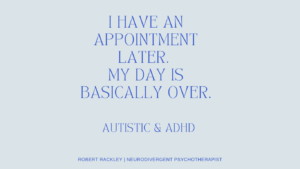
Many ADHD adults find that a single appointment can make it difficult to relax, focus, or start other tasks before it happens.