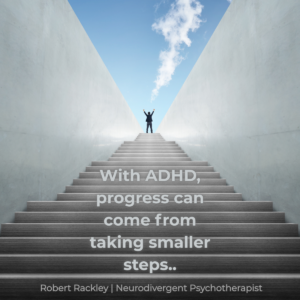
With ADHD, the Future Can Feel Vague
Many adults with ADHD are told that planning ahead is the key to feeling organised, calm, and in control.
Plan the year.
Set long-term goals.
Think about where you want to be in twelve months’ time.
For some people, this works well.
For many adults with ADHD, it doesn’t — and that’s not a personal failure.
When the Future Doesn’t Feel Concrete
With ADHD, the future can feel vague.
Not imagined clearly, not emotionally “felt”, and not easy to hold in mind.
This experience is often linked to time blindness — a common ADHD trait where time doesn’t feel linear, predictable, or evenly spaced.
When time blindness is part of ADHD:
the future can feel distant or abstract
long timeframes can be hard to grasp
a whole year ahead can feel overwhelming rather than motivating
Planning far ahead isn’t just cognitively demanding — it can also be emotionally draining.
Why Yearly Planning Can Feel Overwhelming
Yearly planning assumes that time feels solid and measurable.
But for many people with ADHD:
next week can feel just as unclear as next year
long-term goals can feel disconnected from the present
pressure to “have a plan” can trigger anxiety or shutdown
This is why well-intended advice about five-year plans or annual goals can increase stress rather than provide clarity.
It’s not that the goals don’t matter.
It’s that the timeframe doesn’t fit.
A Different Way of Thinking About Planning
For many adults with ADHD, planning can work better when it’s brought closer to the present.
Instead of focusing on the whole year, it may help to focus on:
the next month
the next week
or simply “what’s next”
Shorter timeframes can feel more real, more manageable, and less overwhelming.
This isn’t avoidance.
It’s adaptation.
Mental Health and Planning Pressure
Mental health often suffers when expectations don’t match how the brain works.
When planning feels too big or too vague:
anxiety can increase
self-criticism can creep in
people may feel like they’re “failing at adulthood”
Reducing the pressure to plan far ahead can ease this.
Mental health often improves not when we push harder, but when we plan in ways that reduce overwhelm and support regulation.
Planning Differently Isn’t Planning Badly
Planning with ADHD doesn’t have to look like everyone else’s version of planning.
It can be:
flexible
short-term
revisited often
responsive to energy and capacity
Planning differently doesn’t mean you lack ambition.
It means you’re working with how your mind experiences time.
A Gentler Perspective
If yearly planning feels overwhelming, that makes sense.
It may not be a motivation issue.
It may not be a discipline issue.
It may simply be time blindness doing what it does.
Smaller steps, shorter horizons, and reduced pressure are not signs of failure — they’re often signs of self-understanding.
A Supportive Next Step
Many adults seek therapy not because they don’t want to plan or grow, but because constant pressure to “think ahead” leaves them anxious and exhausted.
ADHD-affirming psychotherapy can offer space to understand time blindness, reduce overwhelm, and find planning approaches that support both functioning and mental health.
You can learn more about my work and resources at:
www.robertrackley.ie