ADHD Shame Often Comes From Misunderstood Potential and Not Lack of Ability
ADHD Shame and the Myth of “Wasted Potential”
Many adults with ADHD grow up hearing the same messages:
“You’re so capable.”
“You have so much potential.”
“If you’d just apply yourself…”
Over time, these comments can quietly turn into shame.
Not because ability is missing — but because ADHD is misunderstood.
When effort, consistency, or productivity don’t look the way others expect, people with ADHD are often judged through a neurotypical lens. The result isn’t motivation. It’s self-doubt.
How Shame Develops in ADHD
ADHD is not a lack of intelligence, ambition, or care.
It’s a difference in how attention, energy, emotion, and executive functioning work.
Yet many people with ADHD internalise messages such as:
“I should be doing more by now”
“Other people manage this — why can’t I?”
“I’m falling behind”
“I’m not living up to my potential”
Over time, these beliefs can lead to:
Chronic self-criticism
Anxiety and low mood
Burnout
Avoidance or shutdown
A sense of being “fundamentally behind” in life
This is not a personal failure. It’s a mismatch between expectation and neurodivergent reality.
Misunderstood Potential vs. Real Ability
Potential is often measured by neurotypical markers:
Linear career paths
Consistent productivity
Predictable energy
Meeting timelines without support
ADHD rarely fits neatly into those boxes.
Many people with ADHD:
Perform exceptionally well in interest-based or crisis situations
Think creatively and intuitively
Show deep empathy and insight
Work in bursts rather than steady output
Need different conditions to access their strengths
When those strengths aren’t recognised — or when environments aren’t adapted — shame grows.
But the issue isn’t ability.
It’s context.
The Impact on Mental Health
Living under constant comparison to neurotypical norms can quietly damage mental health.
Shame often shows up in therapy as:
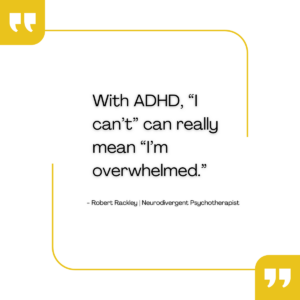
“I know what I should do, but I can’t”
“I feel like I’ve wasted years”
“I don’t trust myself anymore”
“I’m always catching up”
For many adults, an ADHD diagnosis later in life brings both relief and grief:
Relief that there’s an explanation — and grief for years spent blaming themselves.
A More Helpful Reframe
ADHD shame begins to loosen when the question changes from:
“What’s wrong with me?”
to
“What support, environment, or understanding has been missing?”
Healing doesn’t come from pushing harder or trying to become more neurotypical.
It comes from:
Understanding how ADHD actually works
Reducing unhelpful comparisons
Softening unrealistic expectations
Building systems that fit your brain
Developing self-compassion instead of self-criticism
This is not about lowering standards.
It’s about setting standards that are fair.
ADHD, Therapy, and Rebuilding Self-Trust
ADHD-affirming therapy focuses on:
Untangling shame from identity
Understanding nervous system regulation
Rebuilding confidence after burnout
Working with ADHD traits rather than against them
Progress often looks quieter than people expect — but it’s meaningful.
And most importantly:
Your worth was never dependent on how well you performed under the wrong conditions.
If this resonates, you’re not alone.
Many adults only begin to understand their ADHD after years of carrying shame that was never theirs to hold. Support can make a real difference — not by changing who you are, but by helping you understand yourself with clarity and compassion.
👉 If you’re exploring ADHD or looking for ADHD-affirming therapy, you can learn more about my work or book a session at
www.robertrackley.ie
👉 If you’re early in your journey, my self-paced course Could I Have ADHD? offers a calm, practical starting point.
You don’t need to fix yourself.
You may just need understanding, support, and the right lens.