ADHD and Helping Others: Why Their Tasks Can Feel Easier Than Your Own
By Robert Rackley MSc MIACP
Neurodivergent Psychotherapist | ADHD & Autism Specialist
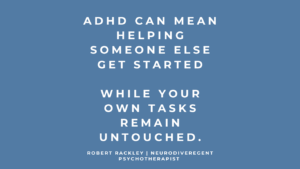
You help a friend organise a form they have been avoiding. You read the questions together, find the missing information and work out what needs to happen next.
You may even enjoy being useful. The task feels clear enough to approach.
Later, you return to your own paperwork. It has been waiting for weeks. You know it matters, but getting started still feels difficult.
That contrast can be painful. “If I can help them do it, why can’t I do the same thing for myself?”
For some adults with ADHD, helping another person happens under very different conditions from managing a task alone. Looking at those conditions can help you understand what support your own task needs.
The ability is there but the conditions differ
ADHD can affect organisation, attention and turning intentions into action. Knowing how to complete a job does not guarantee easy access to those skills at every moment.
The National Institute of Mental Health’s ADHD guidance describes difficulties with everyday responsibilities and recommends practical supports such as written reminders and smaller steps.
This is relevant to ADHD and task initiation. A person can understand the task, care about the outcome and still struggle to begin.
Helping someone else does not remove ADHD. It may change the task in ways that make beginning more accessible. This pattern is not universal, and it is not a diagnostic sign on its own.
Their request may supply the starting point
“Could you help me fill in this section?” is a fairly specific invitation. The form is open. The other person has identified the problem. You know what you are being asked to do.
Your own task may be stored under a much less useful heading: “Sort out my finances.” Before acting, you need to decide what that means, find the documents, choose a priority and work out how long it might take.
Even if the subject is similar, the amount of preparation can differ considerably.
Try comparing the actual steps involved rather than assuming both situations require the same effort. What did the other person have ready that you are still trying to organise?
Company can provide a structure you are missing alone
When you help a friend, there is someone to begin with, ask questions of and check progress with. Their presence may keep the task connected to the current moment.
Some people find a similar benefit when another person quietly works alongside them. Often called body doubling, this does not require the other person to supervise or complete the work.
An exploratory interview study of ADHD task management described participants’ use of shared routines, company and practical support. The paper is available as a preprint and reports experiences rather than testing whether these approaches cause improvement. It does not establish why somebody might find another person’s job easier than their own.
The useful personal question is whether company changes anything for you. It may help, make no difference or become distracting. Support needs to fit the person and the task.
Your own task may carry more emotional history
Someone else’s unfinished form may look like a problem with a next step. Your own form may bring back the last time you forgot a deadline or were criticised for leaving something late.
You may feel you should already have completed it. You might be afraid of discovering a problem, choosing incorrectly or needing help again.
That does not make the difficulty imaginary. It means the task now includes an emotional demand alongside the practical one.
My article on decision fatigue in ADHD and autism explores how choices, uncertainty and previous experiences can add to everyday demands. Naming those demands gives you something more specific to address than “I need to be better at this.”
Helping can feel meaningful and sometimes feel compulsory
Being useful can be satisfying. You may care about the person and enjoy solving a problem together. That is a valid part of the experience.
For some people, there is also pressure to respond immediately because disappointing someone feels uncomfortable. They agree even when they have little time or energy left.
These possibilities should not be treated as interchangeable. Helping a friend is not automatically people-pleasing, and finding your own tasks difficult does not mean you care less about yourself.
Ask whether you are choosing to help or feel unable to say no. You can value the relationship while setting a limit: “I can help you with one section, but I need to finish something of my own afterwards.”
Offer your own task some of the same support
Make the request specific
Imagine the task belonged to someone you cared about. What would you ask them to put in front of you first?
Turn “deal with the paperwork” into an action such as “find the letter and read the deadline.” You do not need to solve the entire problem before beginning that step.
Ask for help with the difficult part
“Can you help me get organised?” can feel too broad. Try “Could you sit with me while I open these letters?” or “Could we work out which of these two jobs needs attention first?”
The request can stay small. You can remain in charge of your decisions while receiving support with starting, sorting or remembering.
Create a shared starting time
If company helps, arrange a short period when you and someone else each work on your own task. Agree whether you want quiet, a brief check-in or help identifying the first action.
Keep the arrangement manageable. It should not become another occasion to feel watched or judged.
Notice the help that made a difference
Was the useful part having the document open, hearing a question aloud, sharing decisions or knowing when to stop?
That information is more valuable than simply deciding you work better under pressure. You may be able to recreate the helpful part without depending on urgency or fear.
This also fits with the idea of a spiky profile: ability and support needs can exist together. Being helpful in one situation does not cancel a need for help in another.
You are allowed to receive support too
I bring lived experience of ADHD to my work as a neurodivergent psychotherapist. I want explanations of these everyday contrasts to lead towards useful support, rather than another reason to criticise ourselves.
You can be the person who helps someone make a start and still need someone beside you when it is your turn. The support you offer others can also be a guide to what might help you.
Therapy training and speaking
I provide ADHD and autism therapy in Limerick and online, including support with executive functioning, self-criticism, boundaries and everyday difficulties. We can explore what makes a task accessible and how to build more workable support around it.
I also provide neurodivergence training and speaking for organisations, healthcare teams and educational settings. You can contact me about therapy or training.
About the author
Robert Rackley MSc MIACP is a neurodivergent psychotherapist based in Limerick, Ireland, specialising in ADHD, autism and neurodivergent mental health. His work combines professional training with lived experience of ADHD.
Related articles
Decision fatigue in ADHD and autism