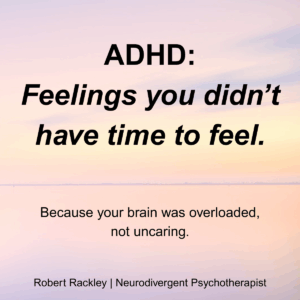
ADHD: Feelings You Didn’t Have Time to Feel
By Robert Rackley MSc MIACP
Neurodivergent Psychotherapist | ADHD & Neurodivergence Specialist
Many ADHD adults don’t feel their emotions on time.
Not because they’re numb.
Not because they don’t care.
But because their brain is already at full capacity.
When your nervous system is overwhelmed, overstimulated, or running in survival mode, your brain puts emotions into the background — not to ignore them, but to cope.
Those feelings don’t disappear.
They queue.
And that emotional backlog can hit later, harder, and unexpectedly.
What Is the ADHD Emotional Backlog?
The ADHD brain often prioritises function over feeling.
When too many demands happen at once — sensory, emotional, social, or cognitive — the brain temporarily suspends emotional processing.
This isn’t emotional avoidance.
It’s neurology.
The backlog can look like:
crying long after the stressful event
anger surfacing hours or days later
feeling shut down during conflict but overwhelmed afterward
emotions arriving all at once after holding everything in
struggling to understand what you feel until the moment has passed
This can be confusing for people around you — and distressing for you.
But it’s important to know:
Your emotions aren’t delayed because they’re wrong.
They’re delayed because your brain was overloaded.
Why ADHD Causes Delayed Emotional Processing
Several ADHD-related factors contribute to emotional backlog:
1. Nervous System Overload
ADHD brains often operate on high alert.
When overwhelmed, the system prioritises “getting through the moment,” not processing feelings.
2. Executive Function Challenges
Emotional understanding and regulation rely on executive functions — the same functions ADHD impacts daily.
3. Masking and Performance Mode
Many ADHD adults push through high-stress situations by masking or dissociating to cope, then crash later.
4. Rejection Sensitive Dysphoria (RSD)
When emotional experiences feel threatening, the brain slows down immediate processing to avoid overload.
5. Chronic Stress and Fatigue
Long-term coping, burnout, and sensory overwhelm all reduce emotional bandwidth.
You’re Not “Too Emotional” — You’re Processing on a Different Timeline
Many ADHD adults feel shame because their emotions seem:
too intense
too late
too unpredictable
But the truth is:
You’re reacting when your brain finally feels safe enough to process.
It’s not overreacting.
It’s delayed reacting.
And it makes complete neurological sense.
How to Support Yourself Through Emotional Backlog
You don’t need to force emotional processing.
But you can support your nervous system gently:
1. Label One Feeling
Ask:
“What did I not have time to feel today?”
Naming one feeling reduces pressure and builds emotional awareness.
2. Create a Quiet Transition Space
Your brain processes emotions when demand drops.
Turning down sensory and cognitive noise helps feelings surface safely.
3. Practice Micro-Grounding
Anchor to:
one object
one texture
one sound
one sensation
This signals safety.
4. Don’t Judge Delayed Emotions
Your timing is valid.
Your emotional experience is real — even if it arrives later.
You’re Not Broken — Your Brain Is Busy
If this resonates, know this:
You’re not failing to feel.
You’re feeling when your brain finally has room.
And that is human.
Not a flaw.
Not a weakness.
Just the reality of an ADHD nervous system trying its best to keep you going.
If you’re looking for support in understanding your ADHD traits and building emotional regulation tools, you can explore my therapist-led ADHD courses here:
👉 www.robertrackley.ie/courses