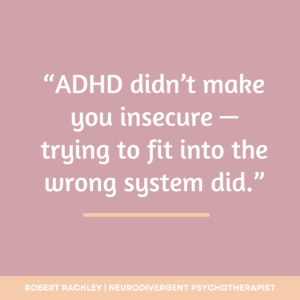
ADHD Didn’t Make You Insecure — Trying to Fit Into the Wrong System Did
By Robert Rackley MSc MIACP
Neurodivergent Psychotherapist | ADHD & Neurodivergence Specialist
When the System Doesn’t Fit
Many ADHD adults grew up trying to fit into systems that were never designed for them — schools, workplaces, even social norms.
You were told to “sit still,” “pay attention,” “be more consistent,” or “stop overreacting.”
So you learned to mask. You overcompensated. You worked twice as hard just to appear “together.”
On the outside, you looked capable.
Inside, it felt like constant performance anxiety.
Over time, that misunderstanding — the sense that you were always falling short — turned into self-doubt.
How Misunderstanding Becomes Insecurity
ADHD doesn’t make you insecure.
Years of trying to be neurotypical enough do.
When you grow up in environments that expect conformity over curiosity, you internalise the message that different means defective.
Each time you were misunderstood, the brain stored it as evidence of failure — even when you were doing your best to adapt.
That chronic mismatch between effort and feedback slowly erodes self-esteem.
It’s not about weakness; it’s about surviving in a world that misread your wiring.
Masking and the Myth of “Together”
Masking — hiding or suppressing your ADHD traits to appear more typical — often starts early.
You study how others behave, mirror their patterns, and work relentlessly to appear competent.
But masking comes at a cost: emotional exhaustion, identity confusion, and an ongoing fear of being “found out.”
It reinforces the idea that your natural self isn’t good enough — and that belonging must be earned through performance.
Reclaiming Self-Worth
Healing begins when you stop trying to fit in — and start building environments that fit you.
Self-esteem for ADHD adults doesn’t come from perfection.
It grows from understanding: knowing that your brain isn’t broken, it’s simply different.
When you design your world around your needs — structure that supports you, people who understand you, and work that engages you — confidence naturally follows.
💡 Try This
Notice where you still push yourself to meet other people’s standards of “normal.”
Ask instead: What actually works for my brain?
Small acts of self-acceptance — using timers, setting flexible routines, or asking for support — are not weaknesses.
They’re ways of building a life that honours how your brain truly functions.
Healing Through Understanding
The goal isn’t to become more neurotypical.
It’s to live more authentically neurodivergent.
When you begin to work with your ADHD rather than against it, shame fades and self-trust returns.
You realise you were never “too much” or “not enough” — you were simply living in a system that didn’t see you clearly.
For more ADHD-focused mental health insights, therapy information, and courses, visit www.robertrackley.ie