
The ADHD tax and the cost of everyday admin

The ADHD tax and the cost of everyday admin

The ADHD tax and the cost of everyday admin

Robert Rackley MSc MIACP | Specialist Psychotherapist, Limerick

The €19.99 charge shows up on your statement and you know exactly what it is. You meant to cancel that free trial. You remembered in the supermarket queue on Saturday and again in the car on Monday. On Tuesday evening, when you had your laptop open and could actually do it, it never crossed your mind.

“ADHD tax” is an informal name for the extra money that everyday tasks can end up costing some people with ADHD. A missed refund, a late fee, another month of a service you barely use. Any one of those can happen to anyone. What can wear you down is paying for the same kind of slip again and again, especially in a week when you needed that €19.99 for something else.

Why you can remember several times and still miss the deadline

Think about what it takes to return a jacket. You have to decide to send it back, find the order email, check the date, get the code, pack the jacket and bring it to a drop-off point while it’s open. By the time the parcel is in the boot, you’ve done most of the work. The shop still has your money. All those steps are part of the invisible load of ADHD.

One part of this is called prospective memory: remembering to do what you intended at a later point. A study by Fuermaier and colleagues found that adults with ADHD had more difficulty planning a complex task than the comparison group, even though both groups recalled their plans similarly. It helps explain why “But you knew you had to do it” can miss the difficulty. Someone can tell you exactly what the job involves and still need help getting from one step to the next.

For more on the experience of remembering everyday tasks, read my article on forgetfulness in adult ADHD.

The detail I’d want to know is when the job was last manageable. If you packed the return straight away and only got stuck because the nearest drop-off point closes before you finish work, a reminder on the front door is unlikely to solve that particular problem.
The cost you don’t see on a bank statement

A late fee has a figure attached to it. The half-hour you spend giving out to yourself afterwards is harder to measure. You may find yourself thinking, “I can run a meeting at work. How am I still paying for an app I used twice?”

That question can follow you into the next task. If opening your banking app means coming face to face with something you feel embarrassed about, it makes sense that you might put it off. And if you share finances, a conversation about a renewal can quickly turn into a much more painful one about whether your partner can rely on you. I explore that tension in ADHD in relationships.

Research on adult ADHD and money gives some context. In a 2019 study, 45 adults with ADHD reported debt more often than 51 adults in a comparison group. Those are group findings. A statement alone can’t tell you why somebody missed a payment. A bill you couldn’t afford on the day it fell due is a different problem from a bill you could pay but lost track of. Each deserves a different response.

Three ways to reduce a recurring ADHD tax

For a subscription, put the route back in the reminder. While the account page is open, copy its link into a calendar entry a few days before renewal. Call it “Open this link and decide whether to keep the app”. Choose a time when you’ll have access to the device and password you need. You’ve just spared your future self a search through old emails.

For a return, choose the handover while you have the order open. If the retailer offers a choice, look for a drop-off point on a journey you already make. Save the QR code where you can find it at the counter. “Drop jacket at the garage when I get petrol on Thursday” gives the parcel a destination as well as a deadline.

For a late bill, identify the bit you keep postponing. Perhaps every bill goes to an inbox you rarely open. Or you see the email, click the link and stop at a forgotten password. Moving the bill to an inbox you use, or recovering that one login, may do more for you than drawing up a whole new budget.

What to do when you have already been charged

If you’ve just spotted an unwanted renewal, check whether it will renew again and decide what you want to do about the next payment. You can also ask the provider to review the recent charge. A brief message is enough: “I’ve just noticed this renewal. I meant to cancel and haven’t used the service since it renewed. Would you consider a refund?” Use that wording only if it fits what happened. The provider may decline.

There’s no need to turn a €20 charge into an evening spent reviewing everything you’ve ever bought. If all you have the energy for today is cancelling the next renewal, that’s a worthwhile place to stop.

From a therapy perspective, the question I’d come back to is “Where were you when you remembered?” For one person the answer is “always in the car”. For another it’s “at my desk, but I knew I’d have to ring them”. Those answers lead to quite different supports. Pick one cost that keeps cropping up in your life and start with what actually happened the last time.

If repeated mistakes are affecting how you feel about yourself, you can read about my approach to ADHD and autism therapy in Limerick and online.

Research and further reading

Fuermaier et al. (2013). Complex prospective memory in adults with attention deficit hyperactivity disorder. PLOS ONE.

Bangma et al. (2019). Financial decision-making in adults with ADHD. Neuropsychology.

Understood. What is the ADHD tax?

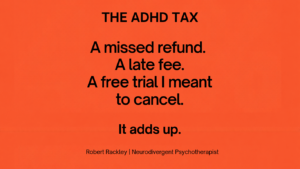
The ADHD tax. A missed refund. A late fee. A free trial I meant to cancel. It adds up. Robert Rackley, Neurodivergent Psychotherapist.
How missed deadlines and forgotten renewals can add to the cost of living with ADHD.

If you have any questions or need assistance please do not hesitate to contact me.