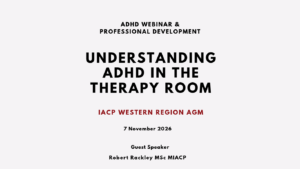
Understanding ADHD in the Therapy Room: Reflections on My IACP Western Region Presentation
By Robert Rackley MSc MIACP
Psychotherapist | ADHD & Autism Specialist | Neurodivergence Trainer & Speaker
On 7 November 2026, I had the pleasure of delivering a presentation on ADHD to members of the Irish Association for Counselling and Psychotherapy (IACP) Western Region as part of their Annual General Meeting.
The presentation provided an opportunity to explore something I feel is particularly important within psychotherapy: understanding ADHD beyond the symptoms most commonly associated with the condition.
When people think about ADHD, they often think about distractibility, hyperactivity, impulsivity or difficulty concentrating.
While these can be important aspects of ADHD, they don’t always capture the complexity of living with the condition, particularly in adulthood.
In therapy, ADHD can influence how someone experiences emotions, communicates, processes information, develops relationships and responds to therapeutic interventions.
My aim was to bring together research, clinical experience and lived experience to help therapists develop a broader understanding of ADHD and its impact on mental health.
Why Understanding ADHD Matters in Psychotherapy
An adult may attend therapy because they’re experiencing anxiety, depression, low self-esteem or difficulties in relationships.
They may describe feeling overwhelmed by everyday responsibilities.
They might struggle with emotional regulation, procrastination or persistent self-criticism.
For some, these difficulties have been present for much of their lives.
Yet ADHD may never have been considered as a possible contributing factor.
This is particularly important for adults whose ADHD was not recognised during childhood.
Someone may have developed ways of coping that make their difficulties less visible.
They may appear capable and organised while privately experiencing considerable mental effort.
If we focus exclusively on the presenting problem without considering possible neurodevelopmental differences, we risk overlooking an important part of the person’s experience.
This doesn’t mean every psychological difficulty is caused by ADHD.
It means recognising that ADHD may be relevant to how someone experiences and manages their mental health.
ADHD Is More Than Attention and Hyperactivity
One of the central themes of my presentation was the importance of looking beyond the more familiar descriptions of ADHD.
ADHD is a neurodevelopmental condition involving differences in attention regulation, activity levels and impulse control.
It can also involve difficulties with executive functioning, including planning, working memory, organisation and task initiation.
These differences can influence many areas of everyday life.
For example, an adult may understand exactly what they need to do but struggle to begin.
They may become overwhelmed by competing demands.
They might experience repeated difficulties remembering appointments or maintaining routines.
Over time, these experiences can affect confidence, relationships and emotional wellbeing.
In therapy, understanding the difference between knowing what to do and being able to do it can be particularly important.
Emotional Regulation and Rejection Sensitivity
Emotional experiences can be an important part of ADHD, although they vary considerably between individuals.
Some adults describe experiencing emotions intensely or finding it difficult to return to a more settled emotional state after becoming upset.
Others describe strong reactions to perceived criticism, rejection or disappointment.
The term rejection sensitive dysphoria, or RSD, is sometimes used to describe particularly painful emotional responses to perceived rejection.
However, RSD is not a separate formal diagnosis, and it is important to avoid treating it as an experience shared by everyone with ADHD.
Within therapy, exploring emotional responses in the context of someone’s broader experiences can be valuable.
An adult who has spent years being criticised for forgetfulness, lateness or apparent disorganisation may have developed significant self-doubt.
Their emotional reactions may also be influenced by previous experiences, relationships, trauma or other mental health difficulties.
Understanding this wider context can help avoid overly simplistic explanations.
Sensory Processing and ADHD
Sensory processing is another area that deserves greater attention.
Some adults with ADHD experience difficulties managing competing sounds, visual distractions or other sensory information.
An environment that appears comfortable to one person may feel distracting or overwhelming to another.
This can have implications for therapeutic practice.
Background noise may make it difficult to concentrate.
Bright lighting may become uncomfortable.
A client may find it easier to talk while moving, using a fidget or looking away.
These behaviours should not automatically be interpreted as disengagement.
For some people, they can be ways of supporting attention or managing sensory demands.
A neurodiversity-affirming therapeutic environment should allow appropriate flexibility wherever possible.
Masking and the Hidden Effort of Coping
Masking was another important topic in the presentation.
Some adults with ADHD work hard to conceal their difficulties or meet expectations that do not come naturally to them.
They may carefully rehearse conversations.
They might develop elaborate organisational systems.
They may hide signs of restlessness or try to appear consistently attentive.
These strategies can be useful, but maintaining them may also involve considerable effort.
A person can appear to be coping while experiencing significant exhaustion.
This is particularly relevant in psychotherapy because the client’s outward presentation may not reflect the demands they are managing internally.
A person who appears calm may feel overwhelmed.
Someone who seems organised may be relying on multiple compensatory strategies.
And someone who is succeeding professionally may still be struggling with everyday functioning.
Recognising this difference between outward presentation and internal experience can support a more complete therapeutic understanding.
How ADHD Can Be Misunderstood in the Therapy Room
One area I wanted to highlight was how ADHD-related difficulties can sometimes be interpreted through a purely psychological or behavioural lens.
For example, a client might repeatedly forget to complete something discussed in therapy.
They may struggle to remember information between sessions.
They might arrive with several issues they want to discuss but find it difficult to prioritise them.
Or they may become distracted during a conversation.
Without considering executive functioning, these experiences could be understood as avoidance, resistance or a lack of commitment.
But there may be other explanations.
Working memory, attention regulation and task initiation can influence a person’s ability to follow through on intentions.
This doesn’t mean therapists should automatically attribute every difficulty to ADHD.
Rather, it highlights the importance of remaining curious about what may be contributing to the client’s experience.
A neurodevelopmental explanation can sometimes change how we understand an apparent difficulty with engagement.
Adapting Therapy to Support ADHD Clients
Neurodiversity-affirming psychotherapy doesn’t necessarily require abandoning established therapeutic approaches.
It may involve adapting how those approaches are delivered.
For example, some clients may benefit from:
- Clearer structure within sessions.
- Written summaries of important points.
- Visual explanations or diagrams.
- Breaking tasks into smaller, manageable steps.
- Flexibility around movement and eye contact.
- Additional support with remembering between-session activities.
- Checking whether therapeutic goals and strategies are realistic for the individual.
These adaptations can make therapy more accessible without reducing its depth or therapeutic value.
Cognitive Behavioural Therapy (CBT), for example, can be adapted to recognise executive functioning differences and the practical difficulties associated with ADHD.
The National Institute for Health and Care Excellence (NICE) recommends structured, supportive psychological interventions focused on ADHD when non-pharmacological treatment is indicated for adults. These interventions may include elements of CBT.
Read NICE guidance on ADHD diagnosis and management
The key is to work collaboratively with the client rather than assume that a standard approach will suit everyone.
The Importance of Lived Experience and Clinical Understanding
As a psychotherapist specialising in neurodivergence, my work brings together clinical experience, specialist education and my own lived experience of ADHD.
I believe these perspectives can complement one another.
Research provides an important foundation.
Clinical experience helps us understand how difficulties may present in therapeutic practice.
Lived experience can offer insight into the everyday realities that are not always visible during an assessment or therapy session.
None of these perspectives should replace the others.
Instead, bringing them together can contribute to a more informed and person-centred approach.
For me, one of the most important aspects of neurodiversity-affirming psychotherapy is recognising that clients are individuals.
Two adults with ADHD may have very different experiences, strengths, needs and mental health difficulties.
Effective therapy needs to reflect those differences.
Reflecting on the IACP Western Region Presentation
I was delighted to receive positive feedback following the presentation, and I appreciated the opportunity to contribute to professional learning within the IACP.
It was encouraging to see continued interest in developing a deeper understanding of ADHD and how it relates to psychotherapy.
For therapists, ongoing professional development in neurodivergence is increasingly important.
A better understanding of ADHD can help us recognise difficulties that may previously have gone unnoticed, avoid unnecessary assumptions and adapt our work to suit individual clients.
The aim is not to explain every presenting difficulty through ADHD.
It is to ensure that neurodevelopmental differences are considered when they are relevant to the person’s experience.
Ultimately, this can contribute to therapy that is more accessible, collaborative and responsive to the individual.
ADHD and Neurodiversity Training for Professionals
Alongside my psychotherapy practice, I deliver specialist ADHD, autism and neurodiversity training for counsellors, psychotherapists, healthcare professionals, educators, workplaces and organisations.
My training combines research, clinical examples, lived experience and practical approaches that professionals can incorporate into their work.
Topics include ADHD in adulthood, autism, sensory processing, emotional regulation, masking, executive functioning and adapting therapeutic approaches for neurodivergent clients.
Training is available through online presentations, professional development workshops, webinars and full-day programmes.
Learn more about my neurodiversity training and speaking.
You can also explore Therapy Unmasked: Neurodivergence Training for Therapists, an online course developed to support more inclusive therapeutic practice.
About Robert Rackley
I am an IACP-accredited psychotherapist based in Limerick, specialising in ADHD, autism and related neurodevelopmental differences.
I provide neurodiversity-affirming psychotherapy for adults, both in person and online.
My work focuses on understanding how neurodevelopmental differences interact with mental health, relationships, emotional wellbeing and everyday functioning.
I also provide specialist training and speaking services for professionals and organisations seeking to develop a more informed and inclusive understanding of neurodivergence.
Learn more about my approach to therapy.
Robert Rackley MSc MIACP
Psychotherapist | ADHD & Autism Specialist | Neurodivergence Trainer & Speaker