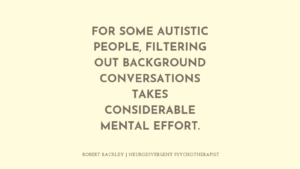
Autism and Background Conversations: Why Listening in Busy Places Can Be Exhausting
By Robert Rackley MSc MIACP
Neurodivergent Psychotherapist | ADHD & Autism Specialist
You’re sitting in a café talking to a friend.
They’re telling you about something important.
You want to listen.
You can hear their voice clearly enough.
But there’s another conversation happening at the table behind you.
Someone is laughing across the room.
Music is playing quietly in the background.
A coffee machine starts making noise.
You try to concentrate on what your friend is saying.
Yet your attention keeps getting pulled towards the other sounds.
Eventually, you realise you’ve missed part of the conversation.
You ask them to repeat themselves.
They might wonder why you’re not listening.
But you have been listening.
You’ve been trying very hard.
For some autistic adults, this experience can make ordinary social situations surprisingly exhausting.
Why Background Conversations Can Be Difficult for Autistic People
When we listen to someone speaking, our brains do more than recognise their words.
We also need to distinguish their voice from other sounds.
In a busy environment, this involves identifying the conversation we want to follow while managing competing information.
This is sometimes called speech-in-noise perception.
Many people can follow a conversation while gradually becoming less aware of background sounds.
However, research suggests that some autistic people experience particular difficulties when several people are speaking at once.
The challenge isn’t necessarily hearing the sounds.
It may involve separating the voice they want to follow from other voices competing for attention.
An autistic person might hear the conversation at the next table very clearly.
They may also hear the person sitting directly in front of them.
But following one conversation while ignoring the other can require significant mental effort.
Hearing Someone Isn’t Always the Same as Understanding Them
This distinction is important.
Someone may hear every word being spoken without being able to follow the conversation comfortably.
Imagine trying to listen to a friend while two other people are speaking nearby.
Your brain is receiving information from several directions.
You might catch individual words from each conversation.
You may find yourself processing fragments of all three.
Meanwhile, the person you’re speaking with has moved on to another part of their story.
Now you’re trying to reconnect with what they’ve said while continuing to manage the sounds around you.
This can be tiring.
It may also become frustrating when someone assumes that hearing their voice means you should have understood everything they said.
Why Social Situations Can Become Exhausting
A busy social environment involves much more than conversation.
There may be music, movement, lighting, smells and people passing nearby.
Someone might be trying to listen while also managing discomfort from the environment.
They may be concentrating on what to say next.
They might be monitoring their own facial expressions or body language.
And they may be trying to avoid appearing distracted.
Each demand can add to the overall effort.
For some autistic adults, the result is that a social occasion they genuinely enjoy becomes exhausting.
They may want to spend time with friends.
They may enjoy meaningful conversations.
They may even feel relaxed emotionally.
Yet the sensory and cognitive demands of the environment can still become overwhelming.
This is why enjoying social interaction and finding it tiring are not necessarily contradictory experiences.
The Emotional Impact of Struggling to Follow Conversations
The difficulty isn’t always limited to the sounds themselves.
It can also affect how someone feels about social situations.
Imagine repeatedly asking people to repeat themselves.
Or missing a joke because you couldn’t follow what was being said.
Perhaps someone asks you a question and you realise you haven’t understood the previous part of the conversation.
You might feel embarrassed.
You may worry that people think you’re uninterested.
Some autistic adults begin avoiding busy environments because they know how much effort these situations require.
Others continue attending but become increasingly exhausted.
They may smile, nod or try to work out what was said from the context.
Over time, this can create anxiety about conversations that other people consider ordinary.
The person may begin to believe they’re simply bad at socialising.
But the difficulty may have less to do with their interest in people and more to do with the environment in which communication is taking place.
What Does Research Tell Us About Autism and Background Noise?
Research has examined how autistic people understand speech when other sounds are present.
A systematic review by Ruiz Callejo and Boets (2023) examined 20 studies investigating speech perception in noise.
The findings suggested that difficulties were particularly apparent when autistic participants needed to distinguish speech from competing speech or certain changing background sounds.
However, performance was often relatively intact when the background consisted of steady noise.
This distinction matters.
It suggests that the type of sound, rather than simply its volume, can influence how difficult listening becomes.
Read the systematic review on speech-in-noise perception in autism
Another review by O’Connor (2012) examined auditory processing in autism and identified differences across several aspects of sound perception.
These findings highlight the complexity of auditory processing rather than suggesting that all autistic people hear sounds in the same way.
Read the review of auditory processing in autism
Not every autistic person experiences these difficulties.
Some may be particularly sensitive to competing voices, while others experience different sensory challenges.
Hearing differences, fatigue, anxiety and environmental conditions can also affect listening.
Persistent or new hearing difficulties should not automatically be attributed to autism.
What Can Make Conversations Easier?
Small environmental adjustments can sometimes make a significant difference.
Choose Quieter Spaces
A quieter café, meeting room or restaurant may make conversation easier.
This doesn’t necessarily mean avoiding social environments.
It means choosing conditions that support comfortable communication.
Consider Where People Sit
Sitting away from speakers, televisions or particularly noisy areas can reduce competing sound.
Some people also find it helpful to sit where they can see the person speaking clearly.
Reduce Unnecessary Background Noise
Turning down music or switching off a television can make conversation more accessible.
In workplaces or educational settings, reducing competing conversations may also help.
Allow People to Ask for Repetition
Asking someone to repeat themselves shouldn’t be treated as a failure.
It may simply mean the listening environment is demanding.
Check What the Individual Finds Helpful
Some autistic people benefit from quieter surroundings.
Others prefer particular seating arrangements, written information or opportunities to take breaks.
There is no single adjustment that will work for everyone.
The most useful approach is to ask rather than assume.
Why This Matters in Therapy, Education and Workplaces
Listening demands can easily be overlooked.
In therapy, a client may be trying to discuss difficult emotions while also managing sounds from outside the room.
A student may be listening to a teacher while hearing conversations elsewhere in the classroom.
An employee may struggle to follow a meeting in a busy open-plan office.
In each situation, the person may appear distracted.
But the environment could be making communication unnecessarily difficult.
For therapists, educators and employers, recognising these differences can change how support is provided.
It may involve choosing a quieter space, reducing background noise, providing written information or allowing someone additional time to process what they’ve heard.
These adjustments don’t remove the need for communication.
They make communication more accessible.
Understanding the Person Behind the Difficulty
One of the challenges autistic people can experience is having their behaviour interpreted without considering what is happening internally.
Someone who looks away may be concentrating.
Someone who becomes quiet may be overwhelmed.
Someone who asks for repetition may be struggling to separate competing voices.
And someone who leaves a busy social environment may simply need relief from the demands of listening.
These experiences shouldn’t automatically be interpreted as disinterest or unwillingness to engage.
Understanding sensory processing allows us to consider another possibility.
The person may want to participate.
They may enjoy the company.
They may have plenty to contribute.
But the environment may be making it harder than it needs to be.
Sometimes meaningful inclusion begins with something as simple as making it easier to hear the conversation.
Related Articles
You may also find these articles helpful:
- ADHD and Sensory Overwhelm
- Fluctuating Capacity in ADHD and Autism
- Why Transitions Can Be Difficult With ADHD and Autism
- Supporting ADHD and Autistic Clients in Therapy
Therapy, Training and Speaking
I provide neurodiversity-affirming psychotherapy for autistic and ADHD adults experiencing sensory processing differences, anxiety, emotional regulation difficulties, burnout and related mental health concerns.
My approach combines clinical experience, specialist training and my own lived experience of neurodivergence.
Therapy can help people understand their sensory needs, develop practical strategies and reduce the emotional impact of repeatedly feeling misunderstood.
Sessions are available in person in Limerick and online.
I also deliver autism, ADHD and neurodiversity training for therapists, healthcare professionals, schools, workplaces and organisations.
Training explores sensory processing, communication differences, executive functioning and practical adaptations that make environments more accessible.
Learn more about my approach to therapy.
Robert Rackley MSc MIACP
Neurodivergent Psychotherapist | ADHD & Autism Specialist | Trainer & Speaker