Autism and the Comfort of Familiar Things: Why Repetition Can Feel Good
By Robert Rackley MSc MIACP
Neurodivergent Psychotherapist | ADHD & Autism Specialist
You have a favourite film.
You’ve watched it dozens of times.
You know what happens.
You remember the dialogue.
You can probably predict exactly when your favourite scene is coming.
But you still enjoy watching it.
Perhaps you listen to the same music regularly.
You choose familiar meals when eating out.
You have particular clothes that feel comfortable.
Or you enjoy returning to places you’ve visited many times before.
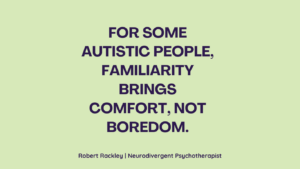
For some autistic adults, these familiar experiences can provide a meaningful sense of comfort.
And although other people might wonder why someone doesn’t want something different, familiarity doesn’t necessarily mean a lack of curiosity or enjoyment.
Sometimes the familiar experience is exactly what someone wants.
Why Familiarity Can Feel Comforting
Much of everyday life involves processing information.
We respond to conversations, sounds, social expectations and changes in our environment.
Even ordinary activities can involve a degree of uncertainty.
What will the food taste like?
How noisy will the restaurant be?
Will the plans change?
What will happen next?
For some autistic people, unfamiliar situations can involve additional sensory, cognitive or emotional demands.
Familiar experiences may reduce some of those demands.
When you already know what to expect, there’s less uncertainty to manage.
You know how the film ends.
You know how the food tastes.
You know how the clothing feels against your skin.
You know what the environment is likely to be like.
That predictability can make the experience feel more manageable.
But familiarity isn’t always about avoiding discomfort.
It can also be a source of genuine pleasure.
Enjoying Something Again Doesn’t Make It Less Enjoyable
There’s a common expectation that enjoyment should involve variety.
Trying a new restaurant.
Discovering new music.
Watching a different film.
Going somewhere you haven’t visited before.
These experiences can be enjoyable, including for autistic people.
But novelty isn’t the only way to experience pleasure.
Someone might listen to the same song because they love the rhythm.
They might revisit a film because the story is meaningful to them.
They may enjoy preparing the same meal because its taste and texture are reliably satisfying.
The familiarity can be part of the enjoyment rather than something that diminishes it.
And someone doesn’t necessarily need a new experience simply because they’ve enjoyed the same one many times before.
The Role of Sensory Experiences
Sensory processing can influence why particular things become familiar favourites.
Think about clothing.
A person may have found a particular jumper that feels comfortable.
They like its weight.
They know how the material feels.
It doesn’t create unwanted sensory discomfort.
Choosing that jumper again may be a sensible way of meeting their sensory needs.
Food can be similar.
A familiar meal offers a known taste, smell, temperature and texture.
Someone may prefer it because they know they’ll enjoy eating it.
A new meal might be appealing on another day, but it can also introduce uncertainty about sensory qualities.
The same principle can apply to music, entertainment and environments.
Familiarity can make it easier to anticipate the sensory experience.
This doesn’t mean every autistic person prefers familiar sensory experiences.
Sensory preferences vary considerably, and some autistic people actively seek novelty, intensity and variety.
The important point is that familiar choices may serve a meaningful purpose for an individual.
Familiarity Isn’t Always About Anxiety
Autism research has explored the relationship between predictability, repetitive behaviours and intolerance of uncertainty.
A 2024 systematic review and meta-analysis identified associations between intolerance of uncertainty, anxiety and restricted or repetitive behaviours in autistic people.
Read the systematic review and meta-analysis
This research is important, but it doesn’t mean every repeated behaviour is driven by anxiety.
A person might repeat an activity because it feels enjoyable.
They may return to something because it’s comforting.
It might be connected to a particular interest.
Or it may simply be their preference.
A 2023 paper examining how rigidity is understood in autism also highlighted the importance of distinguishing different patterns rather than treating them as one uniform characteristic.
Read What Does It Take to Be Rigid? Reflections on the Notion of Rigidity in Autism
Understanding the individual reason matters more than making assumptions based on the behaviour itself.
When Other People Don’t Understand
Imagine telling someone that you’ve watched the same television series several times.
They respond by asking why you don’t watch something new.
Or you choose your favourite meal at a restaurant, and someone insists you should try something different.
These comments may be well-intentioned.
But they can also make somebody feel that their preferences need to be justified.
For an autistic adult who has spent years trying to meet other people’s expectations, this can become another source of pressure.
They may feel obliged to explain why they enjoy familiar things.
They might worry that their preferences appear unusual.
Or they may start choosing things they don’t particularly want because they feel they should.
This can be particularly difficult when the familiar experience is helping them feel comfortable.
Having preferences doesn’t automatically mean someone is restricted by them.
And enjoying the same thing repeatedly doesn’t necessarily mean they’re missing out.
Familiarity and Emotional Regulation
Some familiar experiences can help people manage their emotional state.
After a demanding day, someone might return to a favourite programme.
They know the characters.
There are no unexpected developments.
They can enjoy it without having to concentrate on an unfamiliar storyline.
Another person might listen to familiar music during their journey home.
Someone else might prepare a meal they’ve enjoyed for years.
These activities may offer a predictable experience at a time when the person has already managed considerable demands.
It’s important not to assume that the same activities have the same effect for everybody.
For some people, familiarity is regulating.
For others, different activities may provide a greater sense of comfort.
What matters is understanding what works for that person.
When Familiarity Becomes Difficult to Move Away From
There is also an important distinction between enjoying familiarity and feeling unable to move away from it.
Sometimes changes to familiar routines or experiences can cause significant distress.
This might happen when an important activity becomes unavailable or when unexpected changes are difficult to manage.
In those circumstances, support may help someone develop more options while respecting the value of what is familiar.
For example, if a preferred food is unavailable, it may help to identify alternatives with similar sensory qualities.
If an important routine changes, advance information may reduce uncertainty.
The aim isn’t to remove familiar experiences simply because they’re repeated.
It’s to support the person’s wellbeing, autonomy and ability to manage situations when change is necessary.
Supporting Autistic Adults Without Unnecessary Pressure
A neurodiversity-affirming approach begins with curiosity.
Rather than assuming someone needs to try something new, we can ask what they enjoy about the familiar experience.
Is it the predictable sensory experience?
Does it help them relax?
Is it connected to a meaningful interest?
Does it provide reassurance after a demanding day?
Or do they simply enjoy it?
The answer can help us understand what matters to the individual.
In therapy, this may involve recognising familiar activities as valuable sources of comfort or regulation.
In relationships, it may mean respecting preferences without making them into a problem.
And in workplaces or education, it may involve recognising when predictable environments support participation.
Finding Comfort in What You Already Know
We live in a world that often celebrates novelty.
New experiences.
New opportunities.
New places.
New things to try.
There can be real value in all of these.
But there can also be value in returning to something familiar.
The song you’ve listened to for years.
The meal you know you’ll enjoy.
The film that never seems to lose its appeal.
For some autistic adults, these experiences are not simply habits.
They may provide pleasure, connection, comfort and a welcome sense of predictability.
And sometimes enjoying something familiar doesn’t require any further explanation.
It’s something that matters to the person.
That can be reason enough.
Related Reading
- Why Transitions Can Be So Difficult for ADHD and Autistic People
- Fluctuating Capacity in ADHD and Autism
- Why ADHD Coping Strategies Stop Working
- Healing Isn’t Becoming Someone Else
Therapy, Training and Speaking
I provide neurodiversity-affirming psychotherapy for autistic and ADHD adults experiencing sensory processing differences, anxiety, emotional regulation difficulties and related mental health concerns.
My approach combines specialist training, clinical experience and an understanding of neurodivergent experiences.
Therapy can provide space to explore individual sensory needs, preferences, emotional wellbeing and the ways everyday environments affect mental health.
Sessions are available in person in Limerick and online.
I also deliver specialist neurodiversity training for healthcare professionals, therapists, educators, workplaces and organisations.
My training covers ADHD, autism, sensory processing, executive functioning and practical ways of making environments more accessible.
Learn more about my approach to therapy.
Robert Rackley MSc MIACP
Neurodivergent Psychotherapist | ADHD & Autism Specialist | Trainer & Speaker