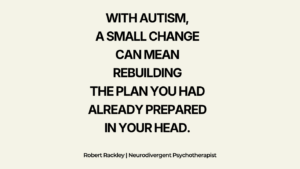
Autism and Changes to Plans: Why a Small Change Can Feel Significant
By Robert Rackley MSc MIACP
Neurodivergent Psychotherapist | ADHD & Autism Specialist
You have agreed to meet someone for lunch. You know the café, the route, where you will park and roughly how long you will stay.
Then a message arrives: “Let’s try somewhere else. It’s only around the corner.”
For the other person, the change may be straightforward. For you, it might reopen questions you had already answered. Where exactly is it? Will there be parking? What is the food like? How noisy will it be? Does the new location affect the rest of your day?
An autistic person can want to meet their friend and still find this change difficult. What looks like one adjustment may require rebuilding several parts of the plan.
A plan can contain much more than a time and place
The visible arrangement might be “lunch at one.” The preparation behind it can be much more detailed.
Perhaps you checked the menu because unfamiliar food is difficult. You chose a seat where you could hear the conversation. You worked out the bus times or left enough time for a quiet break afterwards.
Some of this preparation may be deliberate. Some may have become familiar enough that you no longer notice yourself doing it.
The National Autistic Society’s guidance on predictability and routine explains that knowing details in advance can support autistic people. Preferences and support needs differ, so there is no single plan that every autistic person requires.
One change can reopen several decisions
Imagine a work meeting moving to another building shortly before it begins.
You may need to find a different entrance, allow more travel time, locate the room and work out whether there is somewhere suitable to wait. If the meeting also runs later, the journey home or another commitment may need changing.
The extra demand comes from how the parts connect. Solving one question can create another.
This is related to decision fatigue in ADHD and autism. A person is being asked to make new decisions at a point when they thought the decisions were finished.
“It is only a small change” describes how it looks from one perspective. It does not tell us how much preparation the new arrangement requires.
Uncertainty is not always the same kind of problem
There is a difference between a question you can answer and a situation that keeps changing while you try to prepare.
If you have the new address, you can look up the route. If nobody knows where you are going, when it starts or who will be there, there may be little useful preparation you can do.
A qualitative study involving 15 autistic adults explored different experiences of uncertainty. The researchers described distinctions between familiar situations, things people could find out, and unexpected unknowns that were harder to prepare for. Participants’ sense of control also mattered. A small interview study cannot represent every autistic person, but it offers a useful reason to ask which information or choices would help.
My article on waiting for certainty explores another aspect of uncertainty. Here, the immediate question is what needs updating after an arrangement changes.
Being given a choice can change the experience
A last-minute announcement can leave somebody feeling they must accept the new plan before they have understood what it involves.
They may say yes quickly and become distressed later. They might ask several questions, go quiet or decide they can no longer attend. The meaning of that response needs to be explored rather than assumed.
It can help to offer a real choice: “The café is closed. We could try this nearby place or meet another day. Would you like a few minutes to look at the options?”
The practical problem still needs solving. But the person has time and a role in deciding how to solve it.
Time to replan is part of the adjustment
You may understand the new information immediately and still need time to work out its effects.
This overlaps with transitions and task switching, but changing an arrangement has an additional element: the plan itself needs reviewing. You may be leaving an activity while also trying to establish what now happens next.
Repeatedly asking “Are you ready yet?” can add another demand during that review. A short pause and one clear update may make the situation easier to manage.
Past experience matters too. If previous changes left you without accessible transport, suitable food or a way to leave, your questions may be grounded in practical problems that have happened before.
How to make a changed plan more manageable
Give the update as early as you can
Share confirmed changes promptly. Explain what is known and what is still being decided, rather than presenting guesses as settled arrangements.
Put the revised details together
A short written message can reduce the work of collecting information from several conversations. Include the relevant time, location and any action the person needs to take.
For example: “Same people and start time. New venue is the library meeting room. The entrance is on High Street. Here is the map.”
Ask which detail matters most
Someone might be most concerned about parking. Another person may need to know the food options, who will attend or whether the finishing time has changed.
Ask “What do you need to know about the new arrangement?” before giving a long explanation that misses the main concern.
Keep useful parts of the original arrangement
Where possible, preserve a familiar time, route or person to meet. Be clear about what remains the same, as well as what has changed.
The aim is to reduce unnecessary decisions while making the new situation understandable.
Share the practical work
If you changed the location, you might send the address, check access or help identify a transport option. Replanning does not have to become the sole responsibility of the person who finds the change most demanding.
Allow a pause before expecting an answer
“You can let me know in ten minutes” may give somebody room to consider what is possible. If time is genuinely limited, say so clearly and explain the available choices.
NHS inform’s guidance on supporting an autistic person includes clear communication, advance notice and individual adjustments. The most useful support starts with asking the person what helps them.
If you are the person rebuilding the plan
You might say: “I can consider the new venue, but I need the address and a few minutes to check the journey.”
Or: “A later start changes my transport home. Can we work that out before I agree?”
You do not need a perfect explanation of autism to name a practical need. Sometimes attending with an adjustment is possible. Sometimes the revised arrangement is no longer accessible.
The people involved can work together to understand the difference. Supporting flexibility works better when it includes clear information, time and realistic choices.
Therapy training and speaking
I provide ADHD and autism therapy in Limerick and online, supporting adults with anxiety, sensory demands, self-advocacy and everyday experiences of neurodivergence. As a neurodivergent psychotherapist, I combine professional training with lived experience of ADHD while respecting each person’s own account of being autistic.
I also provide neurodivergence training and speaking for workplaces, healthcare teams and educational settings. You can contact me about therapy or training.
About the author
Robert Rackley MSc MIACP is a neurodivergent psychotherapist based in Limerick, Ireland, specialising in ADHD, autism and neurodivergent mental health. His work combines professional training with lived experience of ADHD.
Related articles
Why transitions can be difficult for ADHD and autistic people
Decision fatigue in ADHD and autism