Why Is Laundry So Hard With ADHD? From Washing to Putting Clothes Away
By Robert Rackley MSc MIACP
Neurodivergent Psychotherapist | ADHD & Autism Specialist
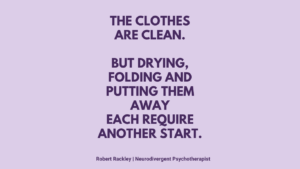
The clothes are clean. They have been clean for days. Yet they are still in the basket, on the chair or waiting to be moved from the drying rack.
You might take what you need straight from the pile. Eventually, clean and worn clothes become mixed together, and you are left wondering whether some of them need washing again.
It can feel difficult to explain why you managed the washing but cannot seem to finish the job. Especially when you are managing work, appointments or other responsibilities that appear much more complicated.
Laundry is a useful example of how ADHD can affect ordinary life. What looks like one household job is actually a sequence of separate actions, with gaps between them and several points where you need to begin again.
Laundry contains more tasks than we acknowledge
Doing the laundry can involve noticing what needs washing, gathering clothes from different rooms, checking pockets, sorting, choosing a programme and finding somewhere to dry everything.
Then you need to remember that the machine has finished. Later, the clothes need to be checked, taken down, sorted, folded or hung up, and moved to wherever they belong.
Each stage asks something slightly different of you. You may need to stop another activity, make a decision, find space or remember an intention formed hours earlier.
The National Institute of Mental Health’s information on adult ADHD describes difficulties with organisation and everyday tasks. Laundry is one practical setting in which those broader difficulties can become visible. It is not a diagnostic test, and struggling with it does not, by itself, mean somebody has ADHD.
Starting the wash does not guarantee finishing the process
Putting a load into the machine creates an immediate action and a clear stopping point. While the machine runs, your attention moves elsewhere.
The next stage arrives later. By then, you may be working, resting, cooking or absorbed in something else. The reminder to move the washing is now competing with what you are already doing.
This is one reason transitions and task switching can be difficult with ADHD or autism. The person may know exactly what needs to happen while finding the change of activity demanding.
Sometimes the problem is remembering. Sometimes it is getting started again. Sometimes the cupboard is full, the drying space is occupied or the person has used up their available energy.
Understanding where the process becomes difficult is more useful than treating every unfinished basket as the same problem.
Sensory demands can add to the work
For some ADHD or autistic people, laundry also involves uncomfortable sensations: wet fabric, strong detergent smells, machine noise, scratchy materials or the heat of an ironing board.
These experiences vary. Someone may find folding calming, while another person finds handling particular fabrics unpleasant. Household space, pain, fatigue and access to equipment also matter.
If sensory demands are part of the difficulty, a stricter schedule may leave the main barrier untouched. My article on ADHD and sensory overwhelm explores why the environment deserves attention alongside the task itself.
The basket can become a source of self-criticism
An unfinished job can quickly acquire a meaning beyond the clothes themselves.
“Why can I never finish anything?”
“Other people manage this.”
“I should have done it yesterday.”
Now, returning to the basket means encountering those thoughts as well as the original task. Avoiding it may bring brief relief, but the clothes remain and the pressure grows.
As a neurodivergent psychotherapist, I want everyday difficulties to be understood without turning them into judgements about someone’s worth. There is still a practical job to do. Understanding the barrier gives us somewhere useful to start.
Make the difficult stage easier
Find the point where things stop
Ask which part repeatedly gets stuck. Is it gathering clothes, moving wet washing, folding or putting everything away?
Choose one stage to adjust. If putting clothes away is the main difficulty, another reminder to start the washing is unlikely to solve it.
Reduce the amount waiting at once
Smaller loads may mean less sorting and a shorter final stage. For some people, washing one category together also reduces decisions afterwards.
That will not suit every household, budget or machine. The useful question is whether the size of the job matches the space, time and energy available.
Let storage do some of the work
Consider whether everything needs folding. Underwear, sleepwear or other suitable items might go directly into labelled drawers or open containers.
Keep storage easy to reach. A system that requires moving several things before opening a drawer creates another barrier. Clean, dry clothes that are easy to find can be a worthwhile outcome, even when the arrangement looks different from someone else’s.
Use a reminder that names the next action
“Laundry” is vague. “Move clothes from the machine to the drying rack” gives a clearer instruction.
An alarm can make the intention visible, but it cannot guarantee that you will be available to act. If necessary, reset it to a realistic time. Avoid building a system that depends on remembering a dismissed notification.
Make restarting smaller
Try putting away five items, sorting one person’s clothes or clearing one part of the rack. You can stop at that agreed point.
This applies the same principle discussed in my article on ADHD and task initiation: make the next action concrete enough to approach.
Ask for specific support
A household member might share one stage, help find storage space or sit nearby while you sort. If another person’s presence helps, agree what feels supportive. Repeated criticism or supervision can add pressure.
Shared household responsibilities also need a fair conversation. An explanation of difficulty can help people agree a workable division of labour.
Support can change as life changes
A system that worked during a quieter period may become difficult when work, caring responsibilities or health demands increase. That is a reason to review the arrangement.
Your laundry routine needs to work in the life you currently have. It does not need to demonstrate how well you can cope without support.
The next time you see the clean basket, try asking: “Which part needs to happen next, and what would make that part easier?”
Therapy training and speaking
I provide ADHD and autism therapy in Limerick and online, exploring everyday difficulties, executive functioning, self-criticism and practical support. If household tasks have become a repeated source of distress, we can look at the demands involved and the changes that might help.
I also provide neurodivergence training and speaking for organisations. You can contact me about therapy or training.
About the author
Robert Rackley MSc MIACP is a neurodivergent psychotherapist based in Limerick, Ireland, specialising in ADHD, autism and neurodivergent mental health. His work combines professional training with lived experience of ADHD.
Related articles
Why transitions can be difficult for ADHD and autistic people