Internalised Ableism in ADHD and Autism: When Self-Criticism Sounds Like Your Own Voice
By Robert Rackley MSc MIACP
Neurodivergent Psychotherapist | ADHD & Autism Specialist
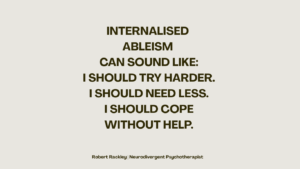
Internalised ableism can sound like:
“I should try harder.”
“I should need less.”
“I should cope without help.”
These thoughts may feel entirely personal. They can sound like ambition, responsibility or a determination to remain independent.
However, they may also reflect messages absorbed over many years.
You may have learned that capable people manage alone.
That needing support means you have failed.
That rest must be earned.
That accommodations give you an unfair advantage.
That struggling only counts when somebody else can see it.
Over time, these beliefs can become part of your internal voice. You may begin demanding things from yourself that you would never demand from another person.
What is internalised ableism?
Ableism includes beliefs, expectations and systems that treat non-disabled ways of functioning as the standard everyone should meet.
It can appear through obvious discrimination. However, it also exists in everyday assumptions about independence, productivity, communication, behaviour and support.
Internalised ableism develops when a disabled or neurodivergent person absorbs those messages and begins applying them to themselves.
Instead of recognising a barrier, they blame themselves for struggling with it.
Instead of asking whether an environment is accessible, they question why they cannot tolerate it.
Rather than using available support, they decide that they should manage without it.
A 2022 study examining internalised ableism and wellbeing described complex psychological, social and physical consequences for disabled young people. The researchers also highlighted the value of supportive relationships, safer spaces, peer connection and solidarity.
Internalised ableism is therefore not simply negative thinking.
It develops within a wider social context.
Not everyone uses the same identity language
Many ADHD and autistic people identify as disabled. Others prefer to describe themselves as neurodivergent without using the word disability.
Both choices deserve respect.
The purpose of discussing internalised ableism is not to impose an identity on somebody. Instead, the concept can help us examine the shame that sometimes becomes attached to having different needs.
It can also reveal why receiving support may feel emotionally difficult, even when the support would make life more accessible.
Not every critical thought represents internalised ableism. People can place unrealistic expectations on themselves for many reasons.
However, the concept becomes useful when the expectation rests on a belief that needing support makes someone weaker, less capable or less worthy.
How society’s expectations become an internal voice
Most people do not consciously decide to believe that their needs are unacceptable.
They learn through repeated experiences.
A child may notice that adults praise them for being easy, independent or undemanding.
At school, they may receive approval when they remain still, tolerate discomfort and complete work without asking questions.
Later, employers may reward them for being constantly available, working through breaks and solving problems without assistance.
Friends or relatives may describe accommodations as special treatment.
Healthcare professionals may minimise difficulties that are not immediately visible.
None of these experiences needs to include the word “ableism” to leave an ableist message behind.
The person may gradually conclude:
“My value comes from how little I need.”
“I am only capable if I can do this without help.”
“I must hide the amount of effort this takes.”
“My difficulty is acceptable only after I have tried everything else.”
The external expectation has now become self-criticism.
“I should try harder”
Many late-diagnosed ADHD and autistic adults have spent years interpreting neurological differences as failures of effort.
Executive dysfunction becomes laziness.
Sensory overload becomes oversensitivity.
Difficulty switching tasks becomes stubbornness.
A need for clear communication becomes inflexibility.
Social exhaustion becomes a lack of resilience.
Because the person does not yet have an accurate explanation, trying harder may appear to be the only solution.
They may create stricter routines.
Work longer hours.
Recheck everything.
Push through exhaustion.
Hide confusion.
Punish themselves after an unproductive day.
Effort can sometimes help. However, effort cannot remove every barrier.
Working harder does not make a noisy environment less overwhelming. Shame does not create working memory. Self-criticism cannot provide additional processing capacity.
When somebody repeatedly applies more pressure to a problem that requires support, they may become exhausted without becoming more able to meet the demand.
“I should need less”
Internalised ableism can make ordinary needs feel excessive.
Someone may feel guilty for requiring:
- Written instructions
- Additional processing time
- Predictable routines
- Reduced sensory input
- Help with administration
- Recovery time after socialising
- Flexible working arrangements
- Reminders or external structure
- Clearer communication
- Support during periods of burnout
- Time to prepare for change
- A different way of completing a task
The need itself may be manageable.
The shame attached to it can make it much heavier.
Instead of asking, “Would this support help me?” the person asks, “Should somebody like me need this?”
That question turns access into a judgement of character.
Your need does not become less real because another person does not share it. Equally, you do not have to prove that you are struggling more than everyone else before support becomes legitimate.
“I should cope without help”
Independence can be meaningful and empowering.
The difficulty begins when independence becomes the only acceptable form of competence.
Human beings rely on support constantly. We use technology, routines, education, healthcare, public services and other people’s knowledge.
However, some forms of support remain socially invisible because most people use them. Other forms become labelled as accommodations because only some people need them.
This difference can create shame.
An ADHD adult may believe using reminders means they are failing to remember properly.
An autistic person may refuse headphones because they worry about appearing difficult.
Someone may avoid requesting written information because they believe they should process speech as quickly as everyone else.
The person is not refusing support because it would be unhelpful. They may be refusing because accepting it feels like admitting something unacceptable about themselves.
Capability and support needs can coexist
Internalised ableism often relies on an all-or-nothing idea of capability.
“If I can do this difficult task, I should manage the easy one.”
“If I have a career, I should be able to organise my home.”
“If I communicate well, I should not need extra processing time.”
“If I managed yesterday, I should manage today.”
Neurodivergent ability is rarely that even.
A person may have considerable skill in one area and significant support needs in another. Capacity can also change with sleep, health, stress, sensory demands and emotional load.
A spiky profile explains how strengths and difficulties can coexist within the same person.
Support does not cancel capability.
Neither does capability remove the need for support.
Both can be true.
Masking can reinforce internalised ableism
Masking involves consciously or unconsciously hiding neurodivergent traits to meet social expectations.
A person may suppress movement, rehearse conversations, force eye contact or imitate expected social behaviour.
They may also hide their needs.
For example, they might pretend to understand, tolerate sensory pain or continue working while overwhelmed. Some avoid helpful supports because using them would make their neurodivergence visible.
As a result, the person may appear to cope successfully.
Other people do not see the preparation, anxiety, recovery time or exhaustion involved.
Eventually, the individual may judge themselves by the same outward appearance they have created for everyone else.
“I looked fine, so I must have been fine.”
“I managed before, so I have no reason to struggle now.”
“Nobody else thinks I need help.”
The mask becomes evidence against their own experience.
My article on what masking in ADHD and autism really looks like explores how this hidden effort can affect identity, wellbeing and access to support.
Late diagnosis can make the pattern more visible
A late ADHD or autism diagnosis often changes how somebody understands their past.
Experiences previously described as laziness, weakness or personal failure may begin to make sense.
At the same time, diagnosis does not instantly remove the beliefs created during those earlier years.
A person may understand intellectually that they experience executive dysfunction while continuing to call themselves lazy.
They may recognise sensory overload but still believe they should tolerate it.
Although they know that support would help, asking for it may still produce guilt.
This creates a difficult gap between understanding and self-acceptance.
The person has new language for their experience, but their emotional expectations still come from the years before diagnosis.
As I discuss in After a Late Diagnosis, You May Question Your Identity, learning that you are neurodivergent can lead to a much wider reassessment of identity, relationships and coping strategies.
Productivity can become a measure of worth
Internalised ableism often appears through beliefs about productivity.
Rest may feel acceptable only after everything has been completed.
A low-capacity day can feel like a moral failure.
Asking for reduced demands may feel like letting other people down.
Someone might continue working while physically or emotionally depleted because stopping would mean admitting that they cannot keep up.
This pressure becomes particularly harmful when capacity changes.
Stress, illness, burnout, disrupted sleep, hormonal changes or increased responsibilities can make familiar strategies harder to sustain.
Instead of adjusting expectations, the person may intensify their self-criticism.
They remember what they could do previously and use it as evidence against what they can manage now.
However, capacity is not a promise.
Being able to do something once does not create an obligation to do it every day.
Support may feel like an unfair advantage
Some people avoid workplace or educational accommodations because they fear receiving special treatment.
They may worry that colleagues will think they are less capable.
Others feel they must prove that they have exhausted every alternative before requesting support.
However, an accommodation does not remove every challenge or guarantee success.
Its purpose is to reduce a barrier that other people may not face.
Written instructions do not complete the work for somebody.
Noise-reducing headphones do not provide professional expertise.
Flexible hours do not remove responsibilities.
Additional processing time does not supply the answer.
These supports create more equal access to the task.
When support removes an unnecessary barrier, it allows the person’s actual skills to become more available.
Some people wait until they reach crisis
Internalised ableism can create an extremely high threshold for asking for help.
The person may believe that support is only justified when they can no longer continue.
They wait until they are completely exhausted.
Until the deadline has passed.
Until their home has become unmanageable.
Until they have stopped eating regularly.
Until anxiety prevents them from attending work.
Until burnout has removed the capacity they were trying so hard to protect.
By that stage, the support required may be much greater.
Early support can feel undeserved because the problem is not yet severe. Yet that is exactly when support may prevent a crisis.
You do not need to prove that you can survive without assistance before you are allowed to use it.
Internalised ableism can affect relationships
The belief that you should need less can shape close relationships too.
Someone may struggle to tell a partner that they need time alone.
They might agree to social plans despite having no capacity.
A person may hide confusion, minimise pain or avoid asking for clearer communication.
They may also apologise repeatedly for needs that have not harmed anybody.
Underneath these behaviours, there may be a fear:
“If this relationship requires somebody to accommodate me, I will become too much.”
Consequently, the person tries to remain easy.
They become highly attentive to everybody else while becoming disconnected from themselves.
This may look like kindness and flexibility. Sometimes it is.
However, care becomes unsustainable when only one person’s needs are allowed into the relationship.
Internalised ableism is not your fault
Discussing internalised ableism should never become another reason to judge yourself.
Recognising these patterns does not mean you are prejudiced, ungrateful or failing at self-acceptance.
It means you have lived within a culture that communicates strong ideas about independence, productivity and normality.
Those ideas can affect anyone.
Many people also learned these messages while trying to remain safe, accepted or employed. Hiding a need may have protected them from ridicule, rejection or discrimination.
Self-criticism may have helped them push through situations where no meaningful support existed.
Therefore, the aim is not to condemn the coping strategy.
It is to notice whether that strategy is still protecting you or whether it is now causing harm.
Unlearning does not mean abandoning growth
A neurodivergence-affirming approach does not mean that effort no longer matters.
It does not mean avoiding every uncomfortable experience.
Nor does it suggest that ADHD or autism explains every difficulty.
People can learn skills, take responsibility, repair mistakes and make meaningful changes while respecting their needs.
The difference lies in the starting point.
Shame says:
“You must change because the way you are is unacceptable.”
Self-understanding says:
“You deserve support while you work towards what matters to you.”
One approach treats the person as the problem.
The other considers the interaction between the person, the task and the environment.
How to begin recognising internalised ableism
Internalised beliefs often remain invisible until we slow down enough to hear them.
Notice the word “should.”
“I should manage.”
“I should be more consistent.”
“I should not need this.”
“I should have grown out of it.”
Then ask:
- Where did I learn this expectation?
- Would I apply the same standard to another person?
- Does this expectation account for my actual capacity?
- Am I treating support as evidence of failure?
- What barrier am I trying to overcome through shame?
- Would an adjustment make the task more accessible?
- Am I waiting for a crisis before allowing myself help?
- Is this expectation supporting growth, or creating fear?
- What would become possible if I used the support available?
The purpose is not to replace every difficult thought with a positive one.
Instead, these questions help you decide whether the thought is fair, accurate and useful.
Accepting support can take practice
Using support may feel uncomfortable at first.
That discomfort does not necessarily mean the support is wrong.
It may simply feel unfamiliar.
You might begin with something small:
- Asking for instructions in writing
- Using headphones before you become overwhelmed
- Setting a reminder without criticising yourself
- Taking a break before exhaustion
- Saying that you need additional processing time
- Declining one demand when your capacity is limited
- Accepting help without immediately trying to repay it
- Completing a task in a way that works for your brain
- Letting somebody know when a plan is inaccessible
- Using an accommodation without apologising for it
Each experience can offer new evidence.
You can receive help and remain competent.
You can have needs and remain respected.
You can rely on support without losing your independence.
Community can help challenge shame
Internalised ableism often grows through isolation.
When you believe everyone else manages easily, your difficulties appear to confirm that something is wrong with you.
Hearing other disabled and neurodivergent people describe similar experiences can change that understanding.
You begin to recognise patterns that are not individual failures.
You discover language for experiences you had never been able to explain.
Furthermore, you see people using support without becoming less capable, intelligent or valuable.
Research into internalised ableism has also highlighted positive peer relationships and solidarity as important influences on wellbeing.
Community does not remove every barrier.
However, it can make it easier to recognise that the barrier was never yours alone to carry.
Organisations also have responsibility
The person should not carry the entire responsibility for unlearning internalised ableism while continuing to navigate inaccessible systems.
Schools, workplaces, healthcare services and therapeutic settings can examine the messages they communicate.
Do they praise people for working beyond their capacity?
Must somebody disclose deeply personal information to receive a simple adjustment?
Are employees treated as less committed when they set boundaries?
Does support arrive before crisis, or only after performance declines?
Are different communication and working styles respected?
Can people ask for help without risking humiliation?
An inclusive environment does more than permit accommodations.
It communicates that using them will not reduce somebody’s status or credibility.
Therapy should not reinforce the same message
A person may enter therapy believing they need to become more productive, organised or socially acceptable.
If therapy focuses only on visible performance, it can reinforce internalised ableism.
The client may learn new ways to push through without learning to recognise capacity.
They might become better at hiding distress while remaining disconnected from their needs.
A neurodivergence-affirming approach can still support change. However, it also asks why the difficulty exists and what the person has been expected to carry.
Therapy may involve:
- Recognising inherited beliefs about disability and support
- Understanding masking and people-pleasing
- Separating capability from constant performance
- Developing strategies that work with the person’s brain
- Processing shame connected to needing help
- Learning to recognise capacity before reaching crisis
- Exploring identity after a late diagnosis
- Practising boundaries and self-advocacy
- Making room for grief, anger and self-compassion
As I explore in Healing Isn’t Becoming Someone Else—It’s Learning to Stop Fighting Yourself, meaningful change does not require self-rejection.
You do not have to earn the right to need support
Internalised ableism can sound convincing because it often uses the language of responsibility.
Try harder.
Need less.
Manage alone.
Do not inconvenience anybody.
Keep going.
But responsibility does not mean ignoring your limits until your body or nervous system stops you.
It does not mean refusing tools that make life more accessible.
Nor does it require you to judge yourself for having a different level or type of need.
You can be capable and need help.
You can be independent and rely on support.
You can want to grow without treating yourself as unacceptable.
You can take responsibility without taking blame for every barrier you encounter.
The voice telling you to cope without help may sound like your own.
That does not mean it began with you.
You are allowed to question it.
You are allowed to need what you need.
Therapy, Training and Speaking
I provide neurodivergence-affirming therapy for adults exploring ADHD, autism, masking, internalised shame, burnout, self-criticism and the impact of late diagnosis.
My approach combines clinical experience, specialist training and my lived experience of ADHD. Therapy is not about teaching somebody to suppress their needs more successfully. Instead, it can help them develop a more accurate and compassionate understanding of themselves.
Sessions are available in person in Limerick and online internationally. You can learn more about what to expect from therapy.
I also provide ADHD, autism and neurodiversity training for workplaces, healthcare professionals, therapists, educational settings and organisations. Training can explore internalised ableism, masking, burnout, accommodations and how systems can support neurodivergent people before they reach crisis.
Robert Rackley MSc MIACP
Neurodivergent Psychotherapist | ADHD & Autism Specialist | Trainer & Speaker