ADHD, Autism and Feeling Behind in Life
By Robert Rackley MSc MIACP
Neurodivergent Psychotherapist | ADHD & Autism Specialist
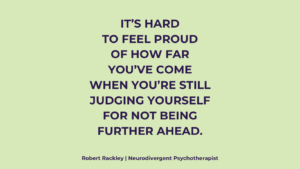
It is hard to feel proud of how far you have come when you are still judging yourself for not being further ahead.
You may have built a career and still believe you started too late.
Completed a qualification but remained focused on how long it took.
Created a stable relationship while judging yourself for the years spent feeling alone.
Learned to understand your needs, only to grieve how long you lived without that understanding.
From the outside, other people may see progress.
Internally, you may see only the distance between your life and the life you believed you should have by now.
For many ADHD and autistic adults, feeling behind in life is not simply dissatisfaction. It can become a painful story about competence, maturity and personal worth.
“I should be more settled.”
“I should be earning more.”
“I should own a home by now.”
“I should find everyday life easier.”
“I should have made better decisions.”
“I should not still need this much support.”
However, those thoughts rarely include the complete context.
They do not include the years spent functioning without an explanation.
They leave out the energy used to manage sensory demands, executive functioning, masking or emotional overwhelm.
Nor do they account for the effect of inaccessible environments, interrupted education, unsuitable work, mental health difficulties or support that arrived too late.
A timeline can show when something happened.
It cannot show what it cost you to get there.
Where the expected timeline comes from
Most people absorb ideas about when life is supposed to happen.
Finish education.
Begin a career.
Become financially secure.
Find a partner.
Buy a home.
Start a family.
Advance professionally.
Become increasingly organised, confident and independent.
These milestones are not wrong. Many people genuinely want them.
The difficulty begins when a common sequence becomes a measure of whether somebody is succeeding at life.
Real lives rarely move in a straight line. People become ill, change careers, care for family members, experience relationship breakdowns, lose jobs, return to education or discover that an earlier goal no longer fits them.
Even so, the expected timeline remains powerful.
A person may make a thoughtful choice not to have children and still feel judged by the cultural expectation that they should.
Someone may enjoy renting yet feel ashamed because home ownership has become associated with adulthood.
Another person may choose part-time work because it protects their health while believing that full-time employment would prove greater success.
The pressure does not always come directly from other people.
Often, it has already become an internal voice.
Why ADHD can contribute to feeling behind
ADHD can affect attention, working memory, planning, organisation, time awareness, emotional regulation and task initiation.
As a result, education or employment may follow a less predictable route.
A person might:
- Change course several times
- Leave education before completing it
- Return to study later
- Perform well but struggle with deadlines
- Lose confidence after repeated criticism
- Move between jobs searching for the right fit
- Experience periods of intense productivity followed by exhaustion
- Struggle with paperwork, finances or household administration
- Need more external structure than other people appear to need
- Avoid opportunities because they do not feel ready
These experiences do not occur because the person lacks intelligence or ambition.
However, they can affect how quickly somebody reaches particular goals.
NICE guidance recognises that ADHD can affect personal, educational, occupational and social functioning. Therefore, understanding ADHD requires looking beyond isolated symptoms and considering its effect on everyday life.
Yet many adults receive no explanation until years after school or college.
Before diagnosis, they may interpret every unfinished course, missed deadline or abandoned plan as a personal failure.
By the time they understand ADHD, they may have spent decades believing they simply lacked discipline.
My article Why ADHD and Autistic Adults Talk Themselves Out of Opportunities explores how self-doubt, perfectionism and fear of rejection can prevent capable people from taking the next step.
Why autistic adults may feel out of step
Autistic adults can also experience pressure around expected milestones.
Education may become difficult because of sensory demands, social uncertainty or the exhaustion of masking.
Employment can be challenging when a person has the skills for the role but struggles with unclear expectations, workplace politics, unpredictable communication or an overwhelming environment.
Relationships may develop differently because conventional dating and social rules feel confusing, inaccessible or unimportant.
Meanwhile, independent living can involve demands that remain largely invisible to other people.
Managing meals, appointments, transport, household tasks, communication and sensory regulation may use significant capacity.
Consequently, a person can have considerable ability in one area while needing substantial support in another.
This is sometimes understood as a spiky profile.
You may be highly knowledgeable but unable to make a necessary phone call.
Perhaps you manage complex responsibilities at work but struggle to prepare food when you get home.
You might communicate confidently about a specialist subject while finding ordinary social interaction exhausting.
These differences do not make somebody immature.
They show that development and ability do not occur evenly across every area of life.
Comparison removes context
Comparison usually involves incomplete information.
You see that another person received a promotion.
You do not see the support they had, the environment they worked in or the personal cost involved.
You notice that somebody bought a home.
Their financial circumstances, family assistance and private difficulties remain invisible.
You see a happy relationship online.
You cannot see the complete reality of that relationship.
At the same time, you compare their visible outcome with your entire internal experience.
You remember every delay.
Every period of burnout.
Every opportunity you avoided.
Every decision you regret.
Every task that still feels harder than you believe it should.
This creates an unequal comparison.
Their life becomes a collection of achievements.
Your life becomes a collection of difficulties.
Social media can intensify this pattern. People generally share announcements rather than the ordinary uncertainty surrounding them.
The new job appears.
The months of rejection do not.
The graduation photograph appears.
The extensions, distress and support behind it may not.
The engagement announcement appears.
The loneliness or difficult relationships that came before it remain private.
Comparison turns different lives into a race while hiding most of the course.
Late recognition can change how you view time
Receiving an ADHD or autism diagnosis later in life can bring relief.
Finally, there may be an explanation for experiences that never made sense.
However, understanding can also bring grief.
You may look back and wonder:
“Would I have chosen a different career?”
“Could I have completed that course with the right support?”
“Would I have stayed in that relationship?”
“Why did nobody recognise how hard I was working?”
“How much time did I spend trying to become somebody else?”
These questions deserve space.
A person does not have to turn every painful experience into a positive lesson.
Some opportunities were genuinely lost.
Certain environments caused real harm.
Earlier support might have made a significant difference.
Therefore, self-compassion should not require somebody to pretend that everything happened for a reason.
My article After a Late Diagnosis, You May Question Your Identity explores how diagnosis can change the meaning of earlier experiences.
The aim is not to erase grief.
Instead, it is to prevent grief from becoming further evidence that your life has failed.
Visible progress and invisible effort
Traditional measures of progress tend to focus on outcomes.
Did you complete the qualification?
Receive the promotion?
Maintain the relationship?
Buy the house?
Reach financial independence?
However, those questions say little about the effort involved.
For one person, attending work may be routine.
For somebody recovering from burnout, returning for two mornings each week may represent enormous progress.
One person may view asking for help as a simple conversation.
For somebody who learned that having needs caused trouble, making that request may require significant courage.
Another person may see turning down an opportunity as a lack of ambition.
Yet declining a role that would damage your health can show growing self-awareness.
Not all progress produces something that other people can see.
Progress may also involve:
- Recognising overload earlier
- Leaving an unsuitable environment
- Asking for an accommodation
- Taking recovery seriously
- Reducing masking where it feels safe
- Setting a boundary
- Beginning again after burnout
- Accepting support
- Choosing sustainability over appearance
- Understanding why something is difficult
- No longer using shame as motivation
These changes may not appear on a CV.
Nevertheless, they can transform a life.
Feeling behind can affect self-esteem
When somebody repeatedly believes they should be further ahead, every difficulty can become personal.
A forgotten bill means they are irresponsible.
An unfinished task means they are lazy.
A career change means they have failed.
Needing support means they are not a proper adult.
Resting means they are falling further behind.
Over time, achievements stop feeling meaningful because the person immediately moves the standard.
They complete something difficult and think:
“I should have done it sooner.”
They receive praise and answer internally:
“If they knew how hard this was, they would think differently.”
They make progress but remain focused on the people who appear further ahead.
Success cannot improve self-esteem when the mind refuses to count it as evidence.
I explore this pattern in ADHD Didn’t Make You Insecure—Trying to Fit Into the Wrong System Did.
Urgency can make progress harder
Feeling behind often creates urgency.
You may believe that you need to fix everything immediately.
Find the right career.
Improve your health.
Organise your home.
Repair relationships.
Build savings.
Return to education.
Become more productive.
The list grows until every part of life feels like an emergency.
That pressure can make prioritising more difficult. It may also increase perfectionism and decision paralysis.
When every choice feels capable of rescuing or ruining your future, even a small decision can become exhausting.
As a result, the person may research endlessly, wait for certainty or attempt several major changes at once.
Eventually, they become overwhelmed and stop.
The pause then appears to confirm the original belief:
“Everyone else is moving forward except me.”
In reality, the demand to catch up may have made sustainable movement almost impossible.
A life built quickly is not necessarily a life that fits
Speed and suitability are not the same thing.
Reaching a milestone quickly does not guarantee that it will support your wellbeing.
A career can look successful while requiring unsustainable masking.
A busy social life can look fulfilling while leaving no time for recovery.
Living independently can appear impressive while the person privately struggles to eat, sleep or manage essential tasks.
Full-time work can represent success for one person and a route towards collapse for another.
Sometimes people reach the expected destination and discover that it was never designed for them.
Therefore, the question is not only:
“How can I get there faster?”
It may also be:
“Do I actually want to go there?”
“Would this life work for my nervous system?”
“Whose definition of success am I following?”
“What would make my life more sustainable?”
“Am I pursuing this because it matters to me, or because I feel ashamed?”
These questions do not remove ambition.
They help ensure that ambition is directed towards a life you can inhabit rather than one you must constantly survive.
Survival can take years that look empty from the outside
Some periods of life do not produce visible achievements.
A person may spend months or years recovering from burnout, depression, trauma, illness or prolonged stress.
During that time, they may feel that life has stopped.
Other people continue progressing while they focus on getting through the day.
However, survival is not inactivity.
It takes effort to continue attending appointments, maintaining basic routines, asking for help or remaining connected when your capacity has reduced.
This does not mean that the period should be romanticised.
Survival can be painful, lonely and deeply unfair.
Still, those years are not proof that you lacked value.
My article on ADHD and autistic survival mode examines how constant coping can become so familiar that somebody no longer recognises its cost.
Grief and pride can exist together
People sometimes feel pressured to choose between grief and gratitude.
Either appreciate how far you have come or grieve what you lost.
In reality, both experiences can exist together.
You can feel proud that you completed a qualification and sad that inaccessible support made it far harder than necessary.
You can value the person you have become while wishing you had understood yourself earlier.
It is possible to appreciate your present relationship and still grieve years of loneliness.
You can celebrate a diagnosis while feeling angry that recognition took so long.
Pride does not cancel grief.
Grief does not make you ungrateful.
Allowing both creates a more honest account of your life.
Measuring progress differently
Feeling behind often comes from using measures that cannot capture your actual experience.
A more helpful reflection might include questions such as:
- Is my life becoming more sustainable?
- Do I understand myself better than I did before?
- Can I recognise overload earlier?
- Am I making choices based on my values?
- Do I recover more deliberately?
- Have I created relationships where I can be honest?
- Am I asking for help sooner?
- Do my routines support me rather than punish me?
- Can I make a mistake without turning it into a judgement of my worth?
- Am I moving towards a life that fits me?
- What have I survived that my current expectations fail to acknowledge?
- Which goals genuinely matter to me now?
These questions do not replace practical goals.
You may still want the career, relationship, home, qualification or financial security.
However, they allow progress to include how you live—not only what you acquire.
Self-compassion is not giving up
Some people worry that reducing self-criticism will remove their motivation.
They believe pressure is the only reason they have achieved anything.
Without it, they fear they will stop trying.
Yet shame rarely creates stable motivation.
It can generate urgency, perfectionism and short periods of intense effort. Eventually, though, it often leaves the person exhausted or afraid to begin.
Self-compassion does not mean saying:
“It does not matter what happens.”
Instead, it means saying:
“This matters, and I do not have to harm myself while working towards it.”
You can remain ambitious without treating your present self as an embarrassment.
Goals can guide you without becoming evidence that you are currently inadequate.
When feeling behind becomes emotionally overwhelming
Occasional comparison is part of being human.
However, the feeling may need greater attention when it begins to affect your mental health.
You may notice:
- Persistent shame
- Hopelessness about the future
- Withdrawing from other people
- Avoiding celebrations because they trigger comparison
- Dismissing every achievement
- Constant pressure to become more productive
- Difficulty resting
- Anxiety about age or time passing
- Believing that others would judge your life
- Feeling that it is too late to begin anything
- Thoughts that your life has little value
These experiences should not be dismissed as a lack of positive thinking.
They may reflect depression, anxiety, burnout, grief or the accumulated effect of years spent feeling inadequate.
If you feel unsafe or believe you may harm yourself, seek urgent support through emergency services, a crisis service or somebody you trust.
You do not need to reach a particular milestone before your distress deserves care.
You have not failed because your life took a different route
Some goals may take longer.
Others may change.
A few may no longer be possible, and that loss can be real.
New goals may emerge once you understand yourself more clearly.
There is no need to pretend that time does not matter.
Age, finances, health and circumstances can affect the choices available.
However, judging yourself cannot return lost time.
It only makes the present another period you will later remember as one spent feeling inadequate.
You are allowed to want more from life.
At the same time, you are allowed to recognise what it took to reach this point.
Progress does not become meaningless because it happened later.
Needing to begin again does not erase what you learned.
Receiving support does not make the achievement less yours.
Taking a different route does not mean you travelled nowhere.
It is hard to feel proud of how far you have come when you are still judging yourself for not being further ahead.
Perhaps pride begins with seeing the whole journey—not only the distance you believe remains.
Therapy, Training and Speaking
I provide neurodivergence-affirming therapy for adults experiencing ADHD, autism, self-doubt, burnout, masking, life transitions and the feeling that they should be further ahead.
My approach combines clinical experience, specialist training and my lived experience of ADHD. Therapy does not require you to lower your aspirations. Instead, it can help you understand what has shaped your path, process grief and build a life that works more sustainably for you.
Sessions are available in person in Limerick and online internationally. You can learn more about what to expect from therapy.
I also deliver ADHD, autism and neurodiversity training for workplaces, healthcare professionals, therapists, educational settings and organisations.
Robert Rackley MSc MIACP
Neurodivergent Psychotherapist | ADHD & Autism Specialist | Trainer & Speaker
Frequently Asked Questions
Why do adults with ADHD often feel behind in life?
ADHD can affect planning, task initiation, time awareness, education, employment and everyday administration. Years of misunderstanding or criticism can also reduce self-trust. However, each person’s experience is different, and ADHD does not determine what somebody can achieve.
Can autistic adults feel behind other people?
Some autistic adults feel out of step with expected milestones involving work, relationships, independent living or social participation. This may reflect sensory, communication and environmental barriers rather than a lack of ability or maturity.
Can a late diagnosis intensify this feeling?
Yes. A late diagnosis may provide an explanation while also creating grief about missed recognition, support or opportunities. Relief and grief can exist together.
How can I stop feeling behind?
The feeling rarely disappears through reassurance alone. It can help to identify whose timeline you are following, include the context behind your progress and choose goals that fit your values and capacity. Therapy may also help when comparison has become connected to persistent shame, anxiety or hopelessness.