Why Showering Can Feel So Difficult With ADHD or Autism
By Robert Rackley MSc MIACP
Neurodivergent Psychotherapist | ADHD & Autism Specialist
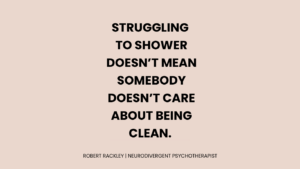
Struggling to shower does not mean somebody does not care about being clean.
They may want to shower.
They may dislike feeling unclean.
They may know they will feel better afterwards.
They may have been thinking about doing it for hours.
Yet they still cannot begin.
From the outside, showering appears to be a straightforward part of everyday life. You turn on the water, wash, dry yourself and get dressed.
However, the brain does not always experience it as one simple task.
For some ADHD and autistic people, showering involves multiple decisions, transitions, sensory changes and executive functioning demands.
The difficulty may not be the shower itself.
It may be stopping the activity that came before it.
Preparing everything required.
Tolerating the change in temperature.
Managing water, noise, smells and physical sensations.
Remembering the sequence.
Washing and drying hair.
Getting out of the shower.
Finding clothes and becoming dry enough to put them on.
When all these demands combine, a routine task can become surprisingly difficult to access.
Difficulty with showering is not a measure of how much somebody cares
Personal hygiene can attract strong judgement.
When somebody showers less often than other people expect, others may assume they are careless, lazy or unaware.
The person may make the same judgement about themselves.
They might think:
“Why can’t I do something this basic?”
“Everyone else manages it.”
“I have been thinking about it all day.”
“It will only take a few minutes.”
“I know I will feel better afterwards.”
“I shouldn’t find this so difficult.”
This creates shame around a task that was already difficult.
Shame may occasionally create enough urgency to force someone into action. However, it rarely makes the task sustainably easier. Instead, showering becomes connected with embarrassment, failure and self-criticism.
The person is no longer only trying to have a shower.
They are also trying to overcome everything the task has come to represent.
A shower is a sequence, not a single action
“Have a shower” sounds like one instruction.
In practice, it may involve:
- Recognising that a shower is needed.
- Deciding when to take it.
- Stopping the current activity.
- Finding a towel.
- Finding clean clothes.
- Going to the bathroom.
- Undressing.
- Adjusting the water.
- Entering the shower.
- Washing the body.
- Washing and rinsing hair.
- Keeping track of what has already been washed.
- Turning off the water.
- Leaving the warmth of the shower.
- Drying the body.
- Managing wet hair.
- Applying any necessary products.
- Getting dressed.
- Dealing with wet towels and clothing.
- Returning to the rest of the day.
Many people complete this sequence without consciously noticing each stage.
A person experiencing executive functioning difficulties may encounter a barrier at several different points.
They may know what to do but struggle to organise and activate the sequence.
They may begin gathering items and become distracted.
They may enter the bathroom but remain unable to undress and turn on the water.
They may enjoy the shower once they are in it but delay getting in for hours.
Alternatively, they may struggle to finish because leaving the warm water requires another transition.
My article on ADHD and task initiation explores the gap that can exist between wanting to do something and being able to begin it.
That gap is not proof that the person does not care.
Intention and access are not always the same thing.
ADHD can make starting routine tasks difficult
ADHD can affect executive functions involved in starting, sequencing, organising and completing tasks.
A person may understand that showering is important while receiving very little internal momentum to begin.
The task may not feel sufficiently urgent, stimulating or immediately rewarding.
Other activities provide faster feedback.
A phone offers constant novelty.
A television programme continues automatically.
Work may have a deadline.
Another person may be waiting.
The shower remains available later.
As a result, the person repeatedly thinks:
“I’ll do it in a few minutes.”
Time passes.
The task stays in the background, using mental energy without being completed.
Eventually, an appointment, social event or fear of being noticed may create enough urgency to act. The person may then shower very quickly before leaving home.
This can be confusing.
If they can shower when they have somewhere to go, why can they not do it on an unstructured day?
The difference may be external urgency.
On an ordinary day, the brain must generate the starting signal internally. Before an appointment, the deadline creates that signal.
This pattern can make the person believe they only respond when a situation becomes stressful.
However, using anxiety as an activation system has a cost. It can turn personal care into another task completed through panic rather than routine support.
Transitions may be the real barrier
A person may describe showering as difficult even when they enjoy being in the shower.
What they struggle with is changing state.
They must move from dressed to undressed.
Dry to wet.
Warm to cold.
Occupied to interrupted.
Comfortable to temporarily uncomfortable.
Then the entire process reverses.
Wet becomes dry.
Warm water becomes cooler air.
The sensory environment changes again.
For ADHD and autistic people who find transitions demanding, each change may require conscious effort.
The current activity can also matter.
If the person is working, gaming, reading, watching something or engaged in a special interest, showering means breaking attention away from an established focus.
Even an enjoyable activity can become difficult to leave.
As I discuss in Why Transitions Are Difficult With ADHD and Autism, changing tasks requires the brain to disengage from one set of demands and activate another. That process can be tiring, especially when attention is deeply engaged or capacity is already low.
The instruction “just go for a shower” may therefore underestimate the most difficult part of the experience.
Showering can create significant sensory demands
Bathrooms can be intense sensory environments.
A person may be managing:
- Bright lighting
- An extractor fan
- Echoing sounds
- Water hitting the skin
- Changes in water pressure
- Water touching the face
- Shampoo near the eyes
- Strongly scented products
- Slippery surfaces
- Steam
- A wet shower curtain touching the body
- The feeling of wet hair
- Water running down the neck or back
- The temperature difference when leaving
- The texture of towels
- Damp skin underneath clothing
- The sound and heat of a hairdryer
Autistic people may experience sensory information more or less intensely than other people. The National Autistic Society explains that autistic people may seek, avoid or become overwhelmed by sensory experiences involving sound, light, smell and texture.
NHS sensory guidance also recognises that water, soap, shampoo, temperature and personal-care products can become difficult for people with sensory differences. The difficulty may relate to one sensation or to several sensations arriving together.
This does not mean that all autistic people dislike showering.
Some find water regulating and actively seek it.
Some prefer baths.
Others prefer showers because a bath involves sitting in water.
One person may need stronger water pressure, while another finds the same pressure painful.
The useful question is not:
“Why can’t you tolerate a normal shower?”
It is:
“Which part of this experience is difficult for your nervous system?”
Getting out can be as difficult as getting in
Showering difficulty is often discussed as an inability to begin.
For some people, leaving the shower is equally difficult.
Once inside, the environment has become predictable.
The water is warm.
The sound is consistent.
The person may feel enclosed and temporarily removed from other demands.
Turning off the water creates another abrupt change.
They must face cooler air, wet skin, drying, dressing and whatever is waiting outside the bathroom.
This can lead to long showers even when starting the shower took considerable effort.
The person may then feel frustrated about the amount of time the process required, making them more likely to avoid it next time.
Understanding both transitions matters.
A strategy focused only on getting into the shower will not help if leaving it remains the greater barrier.
Hair washing may be a separate task
Someone may be comfortable washing their body but find washing their hair much more difficult.
Hair washing can involve:
- Additional time
- Strong scents
- Water near the face and ears
- Closing the eyes
- Repeated rinsing
- Wet hair touching the neck
- Detangling
- Drying
- Noise and heat from a hairdryer
- The weight or sensation of damp hair afterwards
If every shower automatically includes hair washing, the entire task may feel too demanding.
Separating the two can reduce the load.
A body shower does not have to become a full hair-care routine.
Hair can be washed at another time when appropriate. Some people may also find a bath, handheld shower attachment, shower cap, unscented product or different water pressure more manageable.
The aim is not to identify one correct method.
It is to understand the individual barriers.
Exhaustion and burnout can reduce access to personal care
A person may usually manage showering and then begin struggling during a period of stress or exhaustion.
This change can happen when their available capacity decreases.
Work may be using most of their executive functioning.
Parenting or caring responsibilities may leave little recovery time.
Sensory and social demands may have increased.
The person may be experiencing ADHD or autistic burnout.
Tasks that were previously automatic can then require conscious effort. Skills have not necessarily disappeared, but access to them may become inconsistent.
This is one reason someone can continue meeting major external responsibilities while struggling with personal care at home.
They may use their available energy to work, attend appointments, support family members or meet urgent deadlines.
Once those responsibilities are completed, nothing remains for the tasks that affect only them.
My article on why many ADHD and autistic adults do not realise they are burnt out explores how people can remain outwardly functional while losing access to everyday skills.
A sudden change in personal care can therefore provide useful information.
It may indicate that somebody is carrying more than their current capacity can sustain.
Depression, anxiety and physical health can also affect showering
Difficulty showering should not automatically be attributed to ADHD or autism.
Low mood, depression, anxiety, trauma, chronic pain, fatigue, dizziness, mobility difficulties and physical illness can all affect personal care.
Medication changes may also influence energy, motivation, balance or sensory experience.
Sometimes several factors are present together.
A neurodivergent person can also experience depression.
An autistic person can have a physical health condition.
Someone with ADHD can experience chronic pain or fatigue.
Recognising executive or sensory barriers should not prevent other explanations from being considered.
If showering has become suddenly or significantly more difficult, if self-care has declined across several areas, or if the person is experiencing persistent low mood, hopelessness, pain, dizziness or physical symptoms, it is important to seek appropriate medical or mental-health support.
Understanding the task should widen the conversation, not close it.
Shame can make avoidance stronger
When personal care becomes inconsistent, the person may fear that other people will notice.
They may avoid closeness.
Cancel appointments.
Decline invitations.
Work from home.
Keep physical distance.
Use excessive deodorant or perfume.
Avoid discussing the problem, even with a therapist or doctor.
The longer the difficulty continues, the more shame may become attached to it.
Shame can then increase avoidance.
The person does not only have to enter the shower. They must confront the belief that they should never have struggled with it.
Comments such as “That’s disgusting,” “You’re an adult” or “How hard can it be?” may intensify the problem.
Personal hygiene remains important for health, comfort and social participation. A compassionate approach does not require pretending otherwise.
It means recognising that humiliation is not an effective support strategy.
People are more able to discuss barriers when they do not expect to be judged for having them.
Identify the point where the process breaks down
Before choosing a strategy, it helps to identify the actual barrier.
Ask:
- Do I notice when I need a shower?
- Do I remember but keep postponing it?
- Is stopping my current activity difficult?
- Do I have everything I need?
- Is entering the bathroom uncomfortable?
- Is undressing the barrier?
- Is the water unpleasant?
- Do particular smells or textures bother me?
- Is hair washing the hardest part?
- Do I dislike feeling wet afterwards?
- Is getting dressed difficult?
- Does the full process take more energy than I have?
- Am I struggling with other areas of self-care as well?
The answer may change from day to day.
On one day, the main difficulty may be executive functioning.
On another, sensory sensitivity may be higher.
During burnout, every part may feel inaccessible.
A strategy that helps one barrier will not necessarily help another. A reminder may help someone who forgets, but it will not resolve painful sensory input. Changing shampoo will not help if the main difficulty is leaving a preferred activity.
Support becomes more effective when it matches the actual point of difficulty.
Practical ways to make showering more accessible
No strategy will suit everybody. The following ideas can be adapted rather than treated as rules.
Prepare the next step in advance
Place towels, clean clothes and necessary products where they are easy to find.
This reduces the number of decisions required at the point of starting.
If mornings are rushed, preparation can happen the previous evening. If evenings are exhausting, items can be prepared earlier in the day.
Separate showering from hair washing
A short body shower still counts.
Removing hair washing from every shower can make the task smaller and more predictable.
Reduce sensory discomfort
Possible adjustments include:
- Softer or dimmer lighting
- Unscented products
- A different showerhead
- Adjusting the water pressure
- A larger or softer towel
- Warming the room beforehand
- Keeping clothing close to the shower
- Using a shower mat for greater stability
- Playing familiar music or a podcast
- Using ear protection when noise outside the shower is the problem
- Choosing a bath, handheld shower or wash at the sink when these are more accessible
NHS guidance on staying clean and healthy recommends considering lighting, noise, temperature and the wider sensory environment.
Make the beginning smaller
“Have a shower” may feel too large.
The first step could be:
“Put the towel in the bathroom.”
Then:
“Turn on the water.”
The person does not need to hold the entire sequence in mind at once.
This approach is not about pretending that the remaining steps do not exist. It gives the brain one accessible action instead of demanding the whole process immediately.
Attach the shower to an existing routine
Some people find it easier to shower after exercise, before leaving home or immediately after returning from work.
A consistent cue can reduce the need to decide when the task will happen.
However, the routine needs flexibility. Missing the usual time should not mean that the opportunity has been lost for the entire day.
Use external support
A timer, visual checklist, calendar reminder or agreed prompt may help.
Some people benefit from body doubling—the presence of another person while they begin a task. In this context, that does not mean another person enters the bathroom. A partner or housemate might remain nearby while the person gathers clothes and starts the process.
Support should remain respectful and consensual.
Repeated instructions, criticism or monitoring can make the task feel more pressured.
Plan for the transition afterwards
A warm dressing gown, clothes prepared nearby, a familiar drink or a period without immediate demands can make leaving the shower easier.
If wet hair is the main issue, plan for that separately rather than treating it as an unavoidable final stage.
Allow alternatives when necessary
Sometimes a full shower is not accessible.
A wash at the sink, clean clothing, dry shampoo or body wipes may help the person maintain care until they can manage more.
These options do not need to become the permanent solution. They can serve as a bridge on a low-capacity day.
Flexible care is often more sustainable than an all-or-nothing standard.
Supporting somebody without taking away their dignity
If you are supporting a partner, family member or client, begin with curiosity.
You might ask:
“Which part of showering feels hardest?”
“Would changing the products or temperature help?”
“Is it starting, being in the shower or getting out?”
“Would you like a reminder, practical help or no involvement?”
“Would a smaller version feel manageable today?”
Avoid assuming that the person has not noticed.
They may be acutely aware and deeply embarrassed.
It is also important to respect privacy. Support should not become surveillance or infantilisation.
An adult can need help with an everyday task while remaining an adult.
A person can understand why hygiene matters while struggling to carry it out consistently.
A spiky profile helps explain how considerable ability and significant support needs can exist in the same person.
Capability does not make every task equally accessible.
Personal care does not have to be powered by shame
Showering is important.
So is understanding why it has become difficult.
For some ADHD and autistic people, the barrier may involve task initiation, sequencing, transitions, sensory processing or depleted capacity.
For others, the difficulty may relate to depression, anxiety, pain, fatigue, physical health or several overlapping factors.
The person may care greatly about being clean.
They may simply be unable to access the process as consistently as other people expect.
Compassion does not remove the need for personal care.
It creates a better starting point for understanding the barrier and finding support that works.
Struggling to shower does not mean somebody does not care about being clean.
Sometimes it means that a task most people experience as automatic has become complex, uncomfortable or temporarily inaccessible.
Therapy, Training and Speaking
I provide neurodivergence-affirming therapy for adults experiencing ADHD, autism, executive functioning difficulties, sensory overwhelm, burnout, shame and difficulties maintaining everyday routines.
My approach combines clinical experience, specialist training and my own lived experience of ADHD. Therapy is not about judging somebody for the tasks they find difficult. It is about understanding the barriers, reducing shame and developing strategies that fit the person’s actual nervous system and circumstances.
Sessions are available in person in Limerick and online internationally. You can learn more about what to expect from therapy.
I also deliver ADHD, autism and neurodiversity training for therapists, healthcare professionals, educational settings, workplaces and organisations. Training can include executive functioning, sensory processing, burnout and practical ways to support neurodivergent people without treating genuine difficulty as laziness or noncompliance.
Robert Rackley MSc MIACP
Neurodivergent Psychotherapist | ADHD & Autism Specialist | Trainer & Speaker