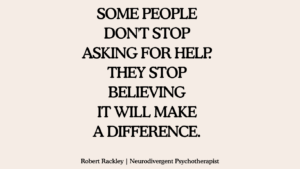
When People Stop Believing That Asking for Help Will Make a Difference
By Robert Rackley MSc MIACP
Neurodivergent Psychotherapist | ADHD & Autism Specialist
Some people don’t stop asking for help because they are better.
They don’t stop because the problem has disappeared, because they have found a way through it, or because they no longer need support.
Sometimes, they stop asking because they have stopped believing that asking will make any difference.
That silence can easily be misunderstood.
From the outside, a person may appear calmer. They may stop mentioning how overwhelmed they feel. They may no longer bring up the difficulties they are having at home, at work, in education or with their mental health.
The people around them may assume that things have improved.
But sometimes the opposite is true.
Sometimes the person has simply learned that explaining themselves takes energy, and that the response they receive rarely justifies the effort.
Asking for help is rarely the first step
By the time many people ask for help, they have already tried to manage alone for a long time.
They may have spent months—or years—telling themselves:
- I should be able to manage this.
- Other people cope with more than I do.
- I just need to try harder.
- Maybe I’m making too much of it.
- I don’t want to be a burden.
- I’ll wait and see if it gets better.
- Perhaps the problem is me.
For many neurodivergent adults, this internal battle can be particularly strong.
ADHD and autistic people often grow up being told, directly or indirectly, that their difficulties are exaggerated, inconsistent or caused by a lack of effort.
If they can do something one day but struggle the next, they may be accused of not trying.
If they appear capable in one area of life, people may assume they should be equally capable in every area.
If they can work, study, care for others or communicate well, their distress may not be taken seriously.
This is part of what makes the idea of “high functioning” so misleading. A person can look capable while using nearly all their energy to maintain that appearance. What looks like coping may actually be high-cost neurodivergent coping.
Asking for help may therefore come only after a great deal of self-doubt, masking and private distress.
When that request is dismissed, minimised or misunderstood, it can confirm the person’s fear that there was no point in speaking up.
What happens when help repeatedly fails?
One unhelpful response may not stop someone from reaching out again.
But repeated experiences can.
Perhaps they tried to explain their exhaustion and were told that everyone gets tired.
They described executive functioning difficulties and were given another planner.
They talked about sensory overwhelm and were told they were being too sensitive.
They explained that they were struggling to begin tasks and were advised to be more disciplined.
They shared how much anxiety they were experiencing, but because they looked calm and communicated clearly, the seriousness of that anxiety was missed.
They tried therapy but spent much of each session explaining or defending the way their brain worked.
They asked for reasonable adjustments and were treated as though they were asking for special treatment.
Over time, the message can become:
Your experience will only be believed if it looks the way other people expect distress to look.
This is particularly harmful for people who mask.
Masking can involve hiding confusion, forcing social interaction, suppressing sensory responses, rehearsing what to say, copying other people’s behaviour or appearing calm while internally overwhelmed.
The better a person becomes at masking, the less likely others may be to recognise their need for support.
They can become so good at appearing to cope that people no longer see how much they are struggling.
Silence does not always mean improvement
When somebody stops talking about their difficulties, we often assume the situation has improved.
But silence can mean many things.
It can mean:
- They are tired of repeating themselves.
- They do not want to be judged again.
- They believe their needs are too much for other people.
- They have begun to minimise their own distress.
- They do not have the energy to explain what is happening.
- They expect to be given advice that does not fit their situation.
- They are afraid of being labelled difficult, dramatic or attention-seeking.
- They have lost trust in the people or services that were supposed to help.
- They no longer know what kind of help to ask for.
Sometimes silence is not recovery.
It is resignation.
The person may continue going to work, answering messages, caring for family members and completing necessary tasks. To others, their life may still look relatively stable.
Internally, however, they may feel increasingly disconnected, exhausted or hopeless.
This is why we need to be careful about using outward behaviour as the only measure of someone’s wellbeing.
A person’s ability to continue functioning does not tell us what that functioning is costing them.
Neurodivergent people often have to translate themselves
Many ADHD and autistic adults do not only have to describe what they are experiencing. They also feel they must translate it into language that other people will accept.
“I can’t do this” may really mean:
- I cannot organise the steps.
- I do not know where to begin.
- The number of decisions involved has overwhelmed me.
- My nervous system is already overloaded.
- I understand what needs to be done, but I cannot access the ability to start.
- I am afraid of getting it wrong.
- I have been pushing myself for too long.
- I do not have enough capacity left.
“I don’t know” may mean that the person cannot identify or communicate what they are feeling in that moment.
“I’m tired” may mean sensory exhaustion, emotional overload, masking fatigue, burnout or the cumulative impact of managing executive functioning difficulties every day.
“I’m fine” may mean, “I do not have the energy to explain this again.”
Neurodivergent adults can spend years translating their experiences into language that other people might understand. When they repeatedly feel misunderstood, they may eventually decide that saying nothing is easier.
Help that does not understand the person can cause further harm
Not all support feels supportive.
Advice can be well-intentioned and still leave someone feeling more alone.
Telling a person with ADHD to “just get organised” does not address executive functioning.
Telling an autistic person to expose themselves repeatedly to an overwhelming sensory environment may ignore the genuine impact of sensory processing differences.
Encouraging somebody to push through burnout without exploring what caused it can intensify their exhaustion.
Focusing only on changing behaviour can miss the reason the behaviour is occurring.
A person who is avoiding something may not be lazy or unmotivated. They may be overwhelmed, uncertain, afraid, dysregulated or unable to organise the steps required to begin.
This is why moving beyond blame is so important. Being neurodivergent is not a personal failure, and support should not be based on forcing a person to appear less neurodivergent.
Effective support begins with curiosity:
- What is making this difficult?
- What happens internally when you try?
- Is the environment contributing to the problem?
- Are there sensory demands involved?
- Is the task unclear or too large?
- Are you afraid of criticism or rejection?
- Have you been masking your difficulties?
- What kind of support would make this feel more manageable?
These questions create space for understanding.
They communicate: I believe there is a reason this is difficult, and I am willing to understand it with you.
When therapy has not helped before
Some people arrive in therapy already unsure whether it will make a difference.
This does not necessarily mean they are resistant to therapy.
It may mean they have tried before and did not feel understood.
They may have been given approaches that did not account for ADHD, autism, sensory processing, alexithymia, executive functioning or differences in communication.
They may have been expected to remember and complete tasks between sessions without support.
They may have found open-ended questions overwhelming.
They may have struggled to explain emotions that they could feel physically but could not easily name.
They may have been told that their difficulties were caused only by anxiety, low confidence or a lack of motivation, without anyone exploring the neurodivergent experiences underneath them.
When somebody has had these experiences, trust may take time.
A helpful therapist does not treat this caution as a problem to overcome. They recognise it as information.
The person may need to know:
- What will be different this time?
- Will I be believed?
- Will I have to defend my diagnosis or identity?
- Will my communication style be respected?
- Can the approach be adapted?
- Will my sensory needs be taken seriously?
- Can I say when something is not working?
- Will I be treated as an equal participant in the process?
Neurodivergence-affirming therapy should make room for these questions. Therapy cannot guarantee that every problem will disappear, but it should give the person an experience of being listened to, respected and involved.
Rebuilding belief takes more than encouragement
When someone no longer believes that asking for help will make a difference, telling them to “reach out” may not be enough.
We also need to consider what happened the last time they reached out.
Were they listened to?
Were their words taken seriously?
Did anyone follow up?
Was the support accessible?
Did the person have to reach crisis point before their needs were recognised?
Were they expected to explain everything clearly while already overwhelmed?
Were promises made but not kept?
Rebuilding trust requires more than reassuring words. It requires experiences that challenge what the person has learned.
That might mean:
- Listening without immediately giving advice.
- Asking what kind of support would actually help.
- Following through on what was agreed.
- Breaking support into manageable steps.
- Providing information in writing.
- Allowing additional processing time.
- Respecting sensory and communication needs.
- Checking in rather than waiting for another crisis.
- Acknowledging when previous support caused harm.
- Being honest about what can and cannot be offered.
Small experiences of being believed can gradually make it safer to ask again.
We need to notice the person who has gone quiet
It is often easier to notice visible distress.
We notice the person who is crying, angry or repeatedly asking for reassurance.
We may be less likely to notice the person who has withdrawn, stopped asking questions or begun saying, “It doesn’t matter.”
But that change deserves attention.
If someone who previously asked for help becomes quiet, we should not automatically assume that the need has disappeared.
We can ask:
- You haven’t mentioned this recently. How are things now?
- Did the support you received make any difference?
- Is there something that made it harder to keep asking?
- Have you felt listened to?
- What would meaningful support look like for you?
- Would it help if we looked at one small part of this together?
The aim is not to pressure the person into talking.
It is to show that their silence has been noticed and that the door remains open.
Asking for help should not require proving you are struggling
People should not have to reach breaking point before their needs are believed.
They should not have to communicate their distress perfectly.
They should not have to appear visibly unwell, lose their job, experience burnout or become unable to function before support becomes available.
A person may be articulate and overwhelmed.
They may be successful and struggling.
They may laugh during a conversation about something painful.
They may understand their patterns intellectually but still need help changing them.
They may know what they “should” do but be unable to access it consistently.
They may appear calm because they have spent a lifetime learning how to hide what is happening internally.
None of these things makes their need for support less real.
Help needs to feel as though it can make a difference
We often encourage people to speak up, reach out and ask for help.
That message matters—but it places responsibility on the person who is already struggling.
We must also ask whether the help available feels safe, relevant and responsive.
Are we listening to understand, or listening only long enough to offer a standard solution?
Are we adapting support to the individual, or expecting the individual to adapt to the support?
Are we recognising neurodivergent communication and distress, or only responding when it appears in familiar ways?
Are we helping people understand themselves, or reinforcing the belief that they are the problem?
Some people do not need more encouragement to ask.
They need an experience of asking that leads to understanding, action or meaningful support.
Because people do not always stop asking for help when they no longer need it.
Sometimes they stop because they no longer believe it will make a difference.
We need to give them a reason to believe that it can.
Therapy, Training and Speaking
I provide neurodivergence-affirming psychotherapy for ADHD and autistic adults, both in person in Limerick and online. My approach combines professional training, clinical experience and my own lived experience of ADHD.
You can learn more about my approach to neurodivergence-affirming therapy or view my therapy fees and booking information.
I also deliver neurodiversity training, CPD programmes, workplace talks and conference presentations for healthcare professionals, therapists, educational settings and organisations.
For adults wondering whether ADHD may explain their experiences, my therapist-led online course, Could I Have ADHD?, provides accessible information, practical guidance and a clear understanding of common ADHD patterns in adulthood.
Robert Rackley MSc MIACP
Neurodivergent Psychotherapist | ADHD & Autism Specialist | Trainer & Speaker
Linked Article Titles
- The High-Functioning Myth: When Neurodivergent Coping Looks Like Thriving
- Many ADHD and Autistic Adults Have Become So Good at Coping That Nobody Realises They Are Struggling
- ADHD and Autistic Adults Spend Years Translating Themselves
- Being Neurodivergent: Moving Beyond Blame
- Neurodivergence and Therapy Explained
- Therapy Fees and Booking Information
- Neurodiversity Training, Speaking and Professional Expertise
- Could I Have ADHD?