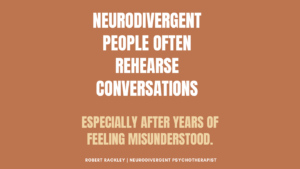
Many neurodivergent people rehearse conversations before they happen.
They may think through every possible response, replay wording in their head, or try to predict how the other person might react. Afterwards, they may replay the conversation again and again, wondering:
“Did I explain myself properly?”
“Did I say too much?”
“Did they misunderstand me?”
“Should I have said that differently?”
From the outside, this can sometimes look like overthinking, anxiety, or being overly sensitive. But for many neurodivergent individuals, there is often something deeper happening underneath.
Years of being misunderstood can shape how safe communication feels.
Many ADHD and autistic individuals grow up being:
- misunderstood
- corrected repeatedly
- judged incorrectly
- told they are “too much”
- accused of being rude, dramatic, emotional, or difficult
- left feeling that their intentions were not understood
Over time, the nervous system learns that communication does not always feel emotionally safe.
So people may begin carefully rehearsing conversations in an attempt to:
- avoid conflict
- reduce misunderstanding
- explain themselves “properly”
- prevent rejection
- feel more emotionally secure
This is especially common in neurodivergent individuals who have spent years masking or adapting themselves socially in order to fit in.
Sometimes rehearsing conversations is not attention-seeking or dramatic behaviour.
Sometimes it is self-protection.
This can also become exhausting. Many people describe:
- mentally preparing for conversations for hours
- replaying interactions late at night
- worrying excessively about tone
- over-apologising
- sending long messages trying to clarify intentions
- feeling panic after small misunderstandings
For many neurodivergent adults, communication is not simply about talking. It is also about emotional safety, previous experiences, and fear of being misunderstood again.
Understanding this can help reduce shame.
Because often, people are not trying to be difficult or “too much.”
They are trying to feel understood.
Neurodivergent-Affirming Therapy & Support
Robert Rackley MSc MIACP is an ADHD & Autism Psychotherapist, Speaker, and CPD Trainer specialising in neurodivergent mental health, masking, burnout, emotional regulation, and therapy adapted for neurodivergent individuals.
Robert provides both online and in-person therapy sessions in Limerick, Ireland, and works with neurodivergent adults across Ireland and internationally.
If you are looking for neurodiversity-affirming therapy, ADHD support, training, public speaking, or online courses, you can learn more at: