ADHD and Depression: The Emotional Exhaustion Many People Never See
Today I had the opportunity to speak alongside Consultant Psychiatrist Michele Hill in an Aware webinar on ADHD and depression.
One theme came up repeatedly throughout the discussion and in the feedback afterwards:
Many adults with ADHD spend years believing they are lazy, failing, inconsistent, or simply not coping as well as everyone else.
But often, what is underneath is exhaustion.
Not a lack of care. Not a lack of intelligence. Not a lack of effort.
Exhaustion.
ADHD and Depression Often Overlap
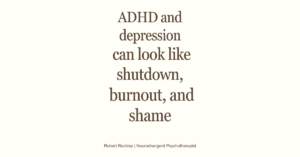
ADHD and depression can become deeply connected over time, particularly when someone has spent years feeling misunderstood, criticised, overwhelmed, or unable to meet expectations placed on them.
Many adults with ADHD are carrying:
- chronic stress
- burnout
- emotional exhaustion
- shame
- low self-esteem
- nervous system overwhelm
- years of masking and overcompensating
Often, they are trying to function in environments that do not suit how their brain or nervous system works.
Over time, this can have a significant impact on mental health.
Depression in ADHD Does Not Always Look Obvious
When people think about depression, they often imagine visible sadness or someone struggling to get out of bed.
But depression in ADHD can sometimes look very different.
It can look like:
- shutting down
- emotional numbness
- withdrawal
- losing motivation
- avoidance
- overwhelm
- chronic procrastination
- irritability
- burnout
- self-criticism
- feeling stuck
- losing belief in yourself over time
Many people with ADHD become experts at masking how much they are struggling internally.
From the outside, they may still appear capable, functioning, or “fine.”
Internally, however, they may feel exhausted from constantly trying to keep up.
The Impact of Shame
One of the most painful parts of ADHD for many adults is not the ADHD itself.
It is the shame that develops around it.
Many people grow up hearing messages such as:
- “You have so much potential.”
- “You just need to try harder.”
- “Why can’t you be more organised?”
- “You are lazy.”
- “You are too emotional.”
- “You never follow through.”
Over time, many ADHD adults begin to internalise these messages.
They stop seeing themselves as overwhelmed and start seeing themselves as flawed.
This is often where depression quietly develops.
Masking and Emotional Exhaustion
A large number of neurodivergent adults spend years masking.
Masking can involve:
- overthinking conversations
- rehearsing interactions
- hiding overwhelm
- forcing eye contact
- suppressing stimming
- over-apologising
- trying to appear “normal” or socially acceptable
- constantly monitoring how they are being perceived
Masking is exhausting.
For many people, it eventually leads to burnout.
And when burnout continues for long enough, depression can follow.
Feeling Seen and Understood Matters
One of the most meaningful parts of today’s webinar was hearing how many people felt “seen” and understood through the discussion.
Many neurodivergent adults have spent years feeling alone in their experiences.
Sometimes simply understanding that there is a reason behind the overwhelm, exhaustion, emotional intensity, or shutdown can reduce a huge amount of shame.
Understanding ADHD through a neurodiversity-affirming lens does not remove struggle.
But it can help people move away from self-blame and towards self-understanding.
Final Thoughts
Many adults with ADHD are not failing because they do not care.
Often, they have spent years surviving in overwhelm while blaming themselves for it.
ADHD and depression are deeply connected for many people, and support needs to move beyond simply telling people to “try harder” or become more organised.
People need understanding. They need support that fits their nervous system. They need environments that are more compassionate and more flexible.
And often, they need help recognising that they were never lazy to begin with.
Robert Rackley provides training, talks, webinars, and consultancy around ADHD, autism, neurodivergence, and mental health for organisations, schools, healthcare services, and professional teams.
For training or speaking enquiries, visit www.robertrackley.ie or get in touch directly.
Robert Rackley MSc MIACP
Neurodivergent Psychotherapist (ADHD & Autism)
CPD Trainer & Speaker on Neurodiversity and Mental Health
www.robertrackley.ie