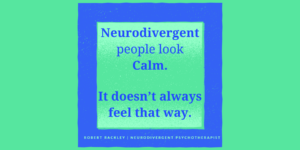
Neurodivergent People Can Look Calm But Feel Overwhelmed
Neurodivergent people can look calm.
They’re quiet.
They’re still.
They seem fine.
But that doesn’t always reflect what’s happening internally.
For many people with ADHD and autistic individuals, calm on the outside can feel very different on the inside.
What Calm Can Feel Like Internally
Calm doesn’t always mean the mind is settled.
For many people, it can mean:
- a busy or racing mind
- overthinking conversations
- analysing interactions
- trying to stay emotionally regulated
- holding everything together
So even when nothing looks wrong…
there can be a lot happening beneath the surface.
The Effort Behind “Looking Calm”
A lot of effort can go into appearing calm.
This might include:
- managing reactions
- masking overwhelm
- choosing what to say (or not say)
- keeping emotions contained
- staying in control in social situations
From the outside, this can look like calm.
But internally, it can feel like constant work.
Why This Often Goes Unnoticed
Calm is often interpreted as coping.
If someone is:
- quiet
- still
- not reacting
it’s easy to assume they’re okay.
But for many neurodivergent people, calm can actually be:
- a form of masking
- a response to overwhelm
- a way of staying regulated
This is why it often goes unnoticed.
Because it doesn’t look like struggle.
The Link Between Calm, Masking, and Burnout
When someone consistently appears calm while managing a lot internally, it can lead to burnout over time.
This is because:
- the nervous system remains activated
- there is little opportunity to fully switch off
- effort builds without being recognised
You might also relate to this:
Why Rest Doesn’t Feel Like Rest for Neurodivergent People
https://www.robertrackley.ie/why-rest-doesnt-feel-like-rest-for-neurodivergent-people-adhd-autism/
A Different Way to Understand Calm
Instead of asking:
“Why are they so quiet?”
It can help to ask:
“What might be going on beneath the surface?”
Because calm doesn’t always mean settled.
Sometimes, it means someone is working very hard to stay that way.
Final Thought
It looks like calm.
But it doesn’t always feel like it.
And understanding that can change how we understand neurodivergence, masking, and mental health.
If this resonates with you, you might find my course helpful:
Could I Have ADHD? – A 1-Hour Clarity Course for Adults
https://www.robertrackley.ie/courses/could-i-have-adhd/
Or if you’d like support, you can learn more about therapy here:
https://www.robertrackley.ie/
I also deliver training and talks on neurodivergence, ADHD, and autism for professionals and organisations.