Why Rest Doesn’t Feel Like Rest for Neurodivergent People
Most people think rest is simple.
Sit down.
Switch off.
Take a break.
But for many neurodivergent people, it doesn’t work like that.
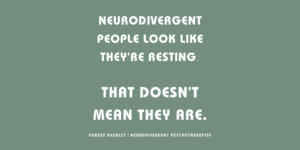
From the outside, it can look like rest.
Someone sitting quietly.
Doing nothing.
Taking time out.
But internally, something very different can be happening.
What’s Happening Internally
For many people with ADHD or for autistic individuals, the mind doesn’t simply switch off.
Even when the body is still, the brain may still be:
- replaying conversations
- analysing what was said
- thinking about what needs to be done
- trying to regulate emotions
- anticipating what’s coming next
So even when everything looks calm, the system can still be highly active.
Why Rest Can Feel Uncomfortable
Because the nervous system is still engaged, rest can feel:
- restless
- uncomfortable
- mentally exhausting
This often leads to a frustrating experience where someone tries to rest but ends up feeling no better—or even worse.
It’s not that they are “bad at relaxing.”
It’s that their system hasn’t actually shifted into a state where rest is possible.
Why This Is Often Misunderstood
From the outside, rest looks obvious.
So when someone says they feel tired after “doing nothing,” it can be misunderstood.
But for many neurodivergent people, doing nothing doesn’t mean the brain is resting.
A lot of effort is still going into:
- managing thoughts
- processing interactions
- regulating internal states
This effort is often invisible—but very real.
What Actually Helps
Rest, for neurodivergent people, often needs to be more intentional.
It can help to think of rest not as “doing nothing,” but as:
1. Giving the mind somewhere to land
Low-demand activities like:
- puzzles
- drawing
- gentle movement
- listening to something familiar
can help the brain settle.
2. Reducing input, not just stopping activity
Instead of full stillness, it may be more helpful to:
- step away from overwhelming environments
- lower sensory input
- create a calmer space
3. Recognising nervous system state
If the system is still activated, rest may not be accessible yet.
In those moments, regulation comes first—rest follows.
A Different Way to Think About Rest
For many neurodivergent people, rest isn’t about stopping.
It’s about feeling safe enough to slow down.
And until that happens,
rest can feel like effort.
Final Thought
It looks like rest.
But it doesn’t feel like it.
And understanding that can change how we approach burnout, recovery, and support.
If this resonates with you, you might find my course helpful:
Could I Have ADHD? – A 1-Hour Clarity Course for Adults
www.robertrackley.ie
Or if you’d like support, you can learn more about therapy here:
www.robertrackley.ie
I also deliver training and talks on neurodivergence, ADHD, and autism for professionals and organisations.