Why Neurodivergent People Feel Tired: It’s Not Just Fatigue
Many neurodivergent people feel tired.
But it’s not always just tiredness.
For many autistic individuals and people with ADHD, feeling tired can be the result of constant mental, emotional, and sensory effort throughout the day.
From the outside, things may look manageable.
But internally, the experience can be very different.
It’s Not Just Being Tired
When most people think of tiredness, they think of:
- a long day
- physical fatigue
- needing rest
But for many neurodivergent people, tiredness often comes from something else entirely.
It can come from:
- sustained focus and attention
- processing conversations and social interactions
- managing sensory input
- adapting to environments
- regulating emotions
This means that even a day that looks “normal” can be mentally exhausting.
The Build-Up of Daily Effort
For many neurodivergent individuals, the effort doesn’t come from one big thing.
It comes from the build-up of smaller demands across the day.
For example:
- a busy or noisy environment
- multiple conversations
- switching between tasks
- maintaining concentration
- navigating social expectations
Each of these requires energy.
Over time, that energy adds up.
Why Recovery Matters More Than Rest
This is where an important difference comes in.
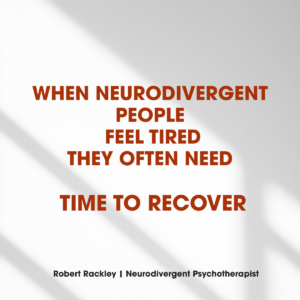
Many neurodivergent people don’t just need rest.
They need recovery.
Rest might mean:
- taking a break
- sitting down
- stopping activity
But recovery often means:
- reducing sensory input
- having time alone
- allowing the nervous system to settle
- stepping away from demands
- giving space for mental processing
Without this kind of recovery, tiredness can continue to build.
Why This Is Often Misunderstood
From the outside, it can look like:
- “It wasn’t that much”
- “It was only a short interaction”
- “They didn’t do anything strenuous”
But what isn’t visible is the effort behind the experience.
This can lead to people feeling:
- misunderstood
- judged
- pressured to keep going
- unsure why they feel so exhausted
The Impact on Mental Health
When recovery isn’t recognised or supported, this ongoing tiredness can impact mental health.
Over time, it can contribute to:
- overwhelm
- anxiety
- burnout
- shutdown or withdrawal
This is not a lack of resilience.
It is often the result of sustained effort without enough recovery.
A Different Way of Understanding Tiredness
When we understand neurodivergence more fully, we begin to shift how we view tiredness.
Instead of asking:
“Why are they so tired?”
We begin to consider:
- what effort has gone into the day
- what demands have been present
- what recovery might be needed
This shift can make a significant difference.
Therapy and Support for Neurodivergent Individuals
If this resonates, you are not alone.
Many neurodivergent adults experience ongoing tiredness without fully understanding why.
Therapy can help you:
- understand your energy patterns
- recognise signs of overwhelm
- build recovery into your routine
- reduce pressure and self-criticism
- develop more sustainable ways of functioning
I provide specialist therapy for neurodivergent individuals, including ADHD and autism.
Sessions are available:
- In person in Limerick
- Online across Ireland and the UK
👉 Book or enquire: www.robertrackley.ie
About Robert Rackley
Robert Rackley MSc MIACP is a psychotherapist specialising in ADHD, autism, and neurodivergent mental health.
He provides therapy, training, and public speaking focused on improving understanding and support for neurodivergent individuals.